A parsec is a length unit used to measure the huge distances of astronomical objects outside the Solar System. A billion parsecs, or about 3.3 billion light years, are called a gigaparsec. Until we discover a multiverse, this is the largest unit of length measurement we’ll ever need. A gigaparsec makes the observable Universe seem quaint, as it stretches only about 28 gigaparsecs across, or about 14,000 cubic gigaparsecs in volume.
0️⃣ Wake Up Before 5.30 AM 4️⃣ Clock In Before 9.00 AM 9️⃣ Money Manager 0️⃣ Shalat / Quran 5️⃣ Vocabulary / Tutorials 1️⃣1️⃣ Blog / Instagram / LinkedIn 2️⃣0️⃣ Highlight / TikTok / Video 3️⃣ Chores / Personal Care / Favor 1️⃣0️⃣ Work / Commute / Go Outside (Hour) 0️⃣ Whatsapp / Discord / DM (Bubble) 0️⃣ Line of Code (Personal Project) 0️⃣ Read (Paragraph / Manga Chapter) 0️⃣*️⃣🔟 Art / Craft / Cuisine / Dessert
Galaxy filaments are clusters of galaxy superclusters, which makes them the largest known structures in the Universe. The appropriately—named Hercules Corona Borealis Great Wall is the largest known galaxy filament — making it the largest known structure in existence.
Galaxy filaments are kind of like the Universe’s countries. If our home country, the Pisces Cetus Supercluster Complex, is the size of Germany, the Hercules Corona Borealis Great Wall is around the size of Russia. An outrageous 10 billion light years across, the HCB Great Wall stretches over a tenth of the way across the observable Universe!
0️⃣ Wake Up Before 5.30 AM 0️⃣ Clock In Before 9.00 AM 0️⃣ Money Manager 1️⃣7️⃣ Shalat / Quran 5️⃣ Vocabulary / Tutorials 1️⃣8️⃣ Blog / Instagram / LinkedIn 2️⃣1️⃣ Highlight / TikTok / Video 2️⃣9️⃣ Chores / Personal Care / Favor 0️⃣ Work / Commute / Go Outside (Hour) 0️⃣ Whatsapp / Discord / DM (Bubble) 0️⃣ Line of Code (Personal Project) 0️⃣ Read (Paragraph / Manga Chapter) 0️⃣*️⃣🔟 Art / Craft / Cuisine / Dessert
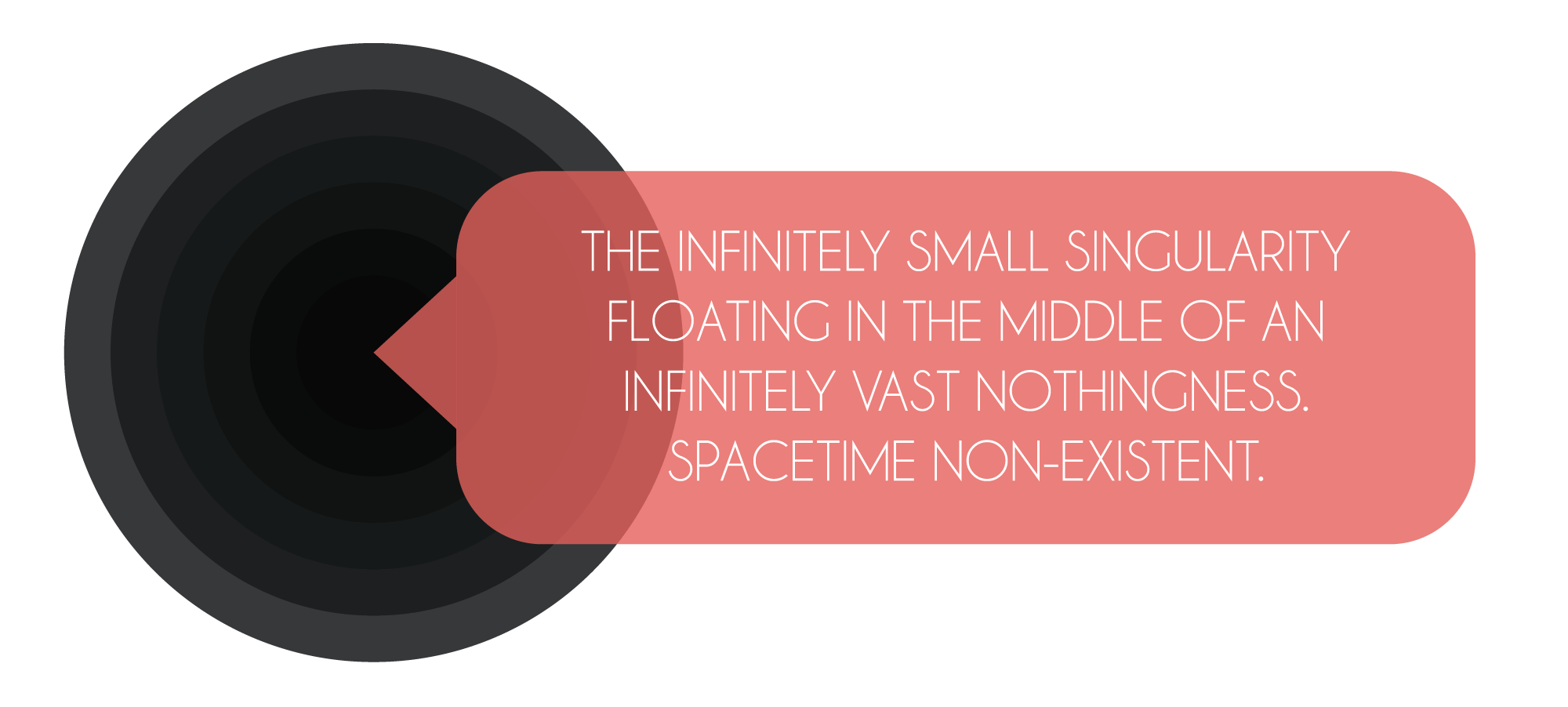
At the very beginning, there was a peculiar object called the singularity, floating in nothingness. How did it get there? That is a mystery. However, before we start exploring this immensely interesting object, we should focus on a different, seemingly trivial expression – nothingness.
Some might think that all the “empty” space around us could be considered nothingness. But that can hardly be the case, given that each centimetre of air contains billions of atoms.
Others might argue that the vacuum of space could be classified as nothingness. After all, vacuum is empty by definition – it contains no matter whatsoever. But there is a catch – vacuum is inside the universe just like everything else around us. And the universe is interwoven with space-time filaments. But space-time certainly is something. It is a specific area where all the laws of our universe are in effect.
For this reason alone, one cannot consider vacuum as complete nothingness, not to mention the immense amount of particles that are being created each second in every single tiny bit of vacuum as a result of quantum mechanics.
But the nothingness around our initial singularity was special and unique – time and space were non-existent and the laws of physics powerless. We would never be able to find such nothingness in our cosmos.
Back to our singularity. It would be fitting to say that it was an exceptionally peculiar object. We do not get to see such objects every day – never, in fact (unless we find ourselves in the centre of a black hole, which would probably not be an unduly pleasant experience – we are going to look into that in one of the following chapters).
Why was the initial singularity so peculiar? First of all, it may have been infinitely small, which is more than remarkable. On top of that, it was infinitely dense and infinitely hot, which makes good sense given that the entire universe had to fit into its heart. Exactly – everything you see around you has once been squeezed into this ancient singularity, though in a somewhat different form.
Suddenly, something incredible happened. Something that may be considered the strangest and most mysterious event of all time. The singularity started rapidly expanding and created the entire unbelievably huge universe. This incident is known under the majestic name of the Big Bang. However, it is rather ironic that we are using this name. First of all, this expression was coined by a man named Fred Hoyle, who was a tremendous opponent of the Big Bang theory (he favoured the competing Steady State theory). He only used this expression to mock the theory. In addition, the term “Big Bang” is incredibly inaccurate – it is far from representing the event that actually occurred.
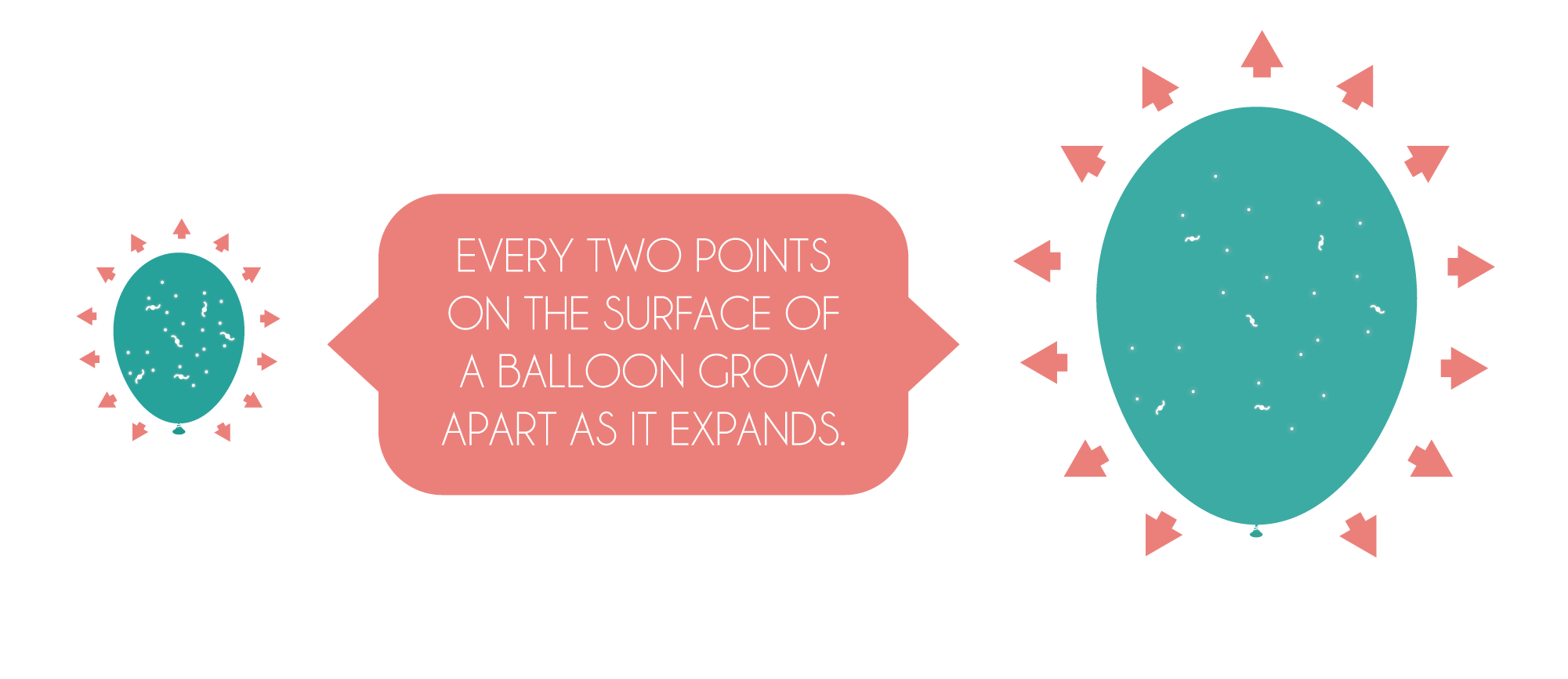
Let us focus on the word Bang first. This word seems to represent a grand explosion accompanied by stunning sound effects. Much to the dismay of action movie fans, the actual “Big Bang” could be considered the exact opposite of such an explosion. There is no sound in vacuum, so let us forget about amazing sound effects. But more importantly, the Big Bang was not an explosion at all – it was more like an inflation of space (incredibly fast inflation indeed).
A great parallel is the inflation of a balloon. Imagine that our universe is represented by the surface of a balloon. If we inflate it, the distance between any two points on its surface increases. This is what the Big Bang and the following expansion of space looked like – it started off as an infinitely small point in the form of a singularity, and ended up as the surface of a gigantic “space balloon”. (Except that the surface of a balloon is a two-dimensional space curved in a third dimension, while our own universe is most likely a three-dimensional space curved in a fourth dimension. However, our primitive three-dimensional brains are not capable of imagining fourth-dimensional space – that is why we are using a simple balloon analogy.)
Now that we grasp the issues with the word Bang, let us focus our attention on the word Big. While the word Bang is utterly inaccurate, the word Big is correct. However, it is a tremendous understatement. The Big Bang was not only big, it was everywhere – every single tiny bit of space used to be condensed in an infinitely small singularity and underwent a whopping expansion. To augment our balloon metaphor, imagine that you are a two-dimensional ant inhabiting the surface of the expanding balloon. For such an ant, the surface of the balloon is the only thing in existence – the ant cannot escape it on its own. From its point of view, everything is inflating. For the sake of accuracy, it would be appropriate to replace the word Big with the word Huge – or even better, Omnipresent.
However, if we put these two accurate expressions together, we get something like the Omnipresent Inflation, which, let us admit, does not sound nearly as good as the Big Bang. We will therefore stick with the usual term, now with the knowledge of its imperfections.
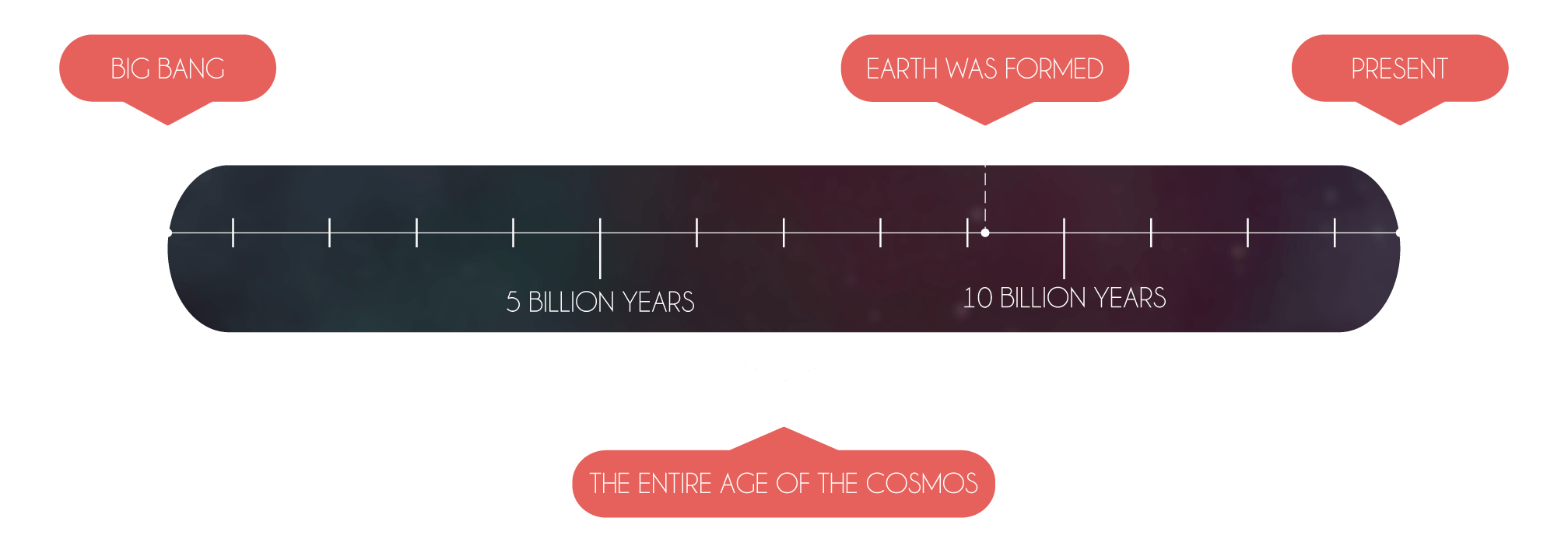
One of the greatest questions is when exactly the Big Bang occurred. This immensely interesting question has been subject to discussion for decades. Today, it is assumed that the singularity started expanding astounding 13.8 billion years ago. You do not even have to try to understand how long ago it was – for the human brain, it is practically impossible. But we can at least try to present this information in a different way – imagine that you put marbles one centimetre (0.4 inches) in diameter next to each other into a single row. If each marble represented one year of the universe’s existence, your row of marbles would go around the entire Earth. Three times. And if you by any chance wanted to live through the whole age of the universe, you would have to live incredible 200 million average human lives. For comparison, the Earth is about 4.6 billion years old – about 67 million lives.
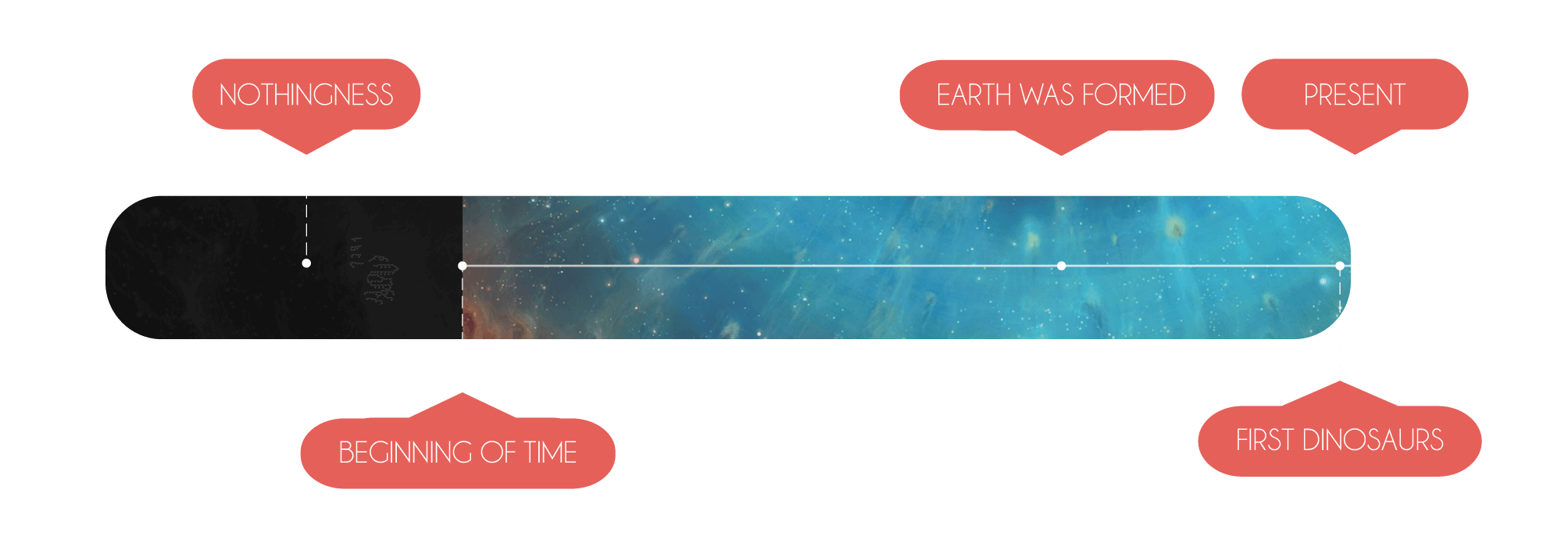
Let us come back to the very beginning now. No one really knows why the Big Bang occurred, but we do know quite well how exactly this process took place. 13.8 billion years ago, the singularity, containing the entire energy of the cosmos, started rapidly expanding. This moment is considered to be the beginning of space-time as well as the universe itself.
But what happened before the Big Bang? This seemingly interesting question is actually pointless. Time is inherently woven into the structure of our universe. Before the Big Bang, it simply did not exist. Asking this question is like wondering about what is located north of the North Pole.
As you have surely already understood, most things about the singularity are extreme and unimaginable. And the super-rapid expansion of the early cosmos right after the Big Bang is surely no exception. Trying to imagine any of the numbers bellow is simply impossible.
About a billionth of a billionth of a billionth of a second after the Big Bang, the universe entered a monumental state known as the cosmic inflation. It should be noted that the temperature of the cosmos at that time was respectable 100 million million million million degrees Celsius! During the cosmic inflation, the universe increased its size in an unimaginable manner. From the initial size of less than a billionth the size of a proton, it inflated to a comparatively huge sphere 1 centimetre (0.4 inches) in diameter. But even more remarkable is the fact that it has managed to alter its size like this in a mere fraction of a second – the cosmic inflation started about 10-37 seconds after the Big Bang and ended somewhere between 10-35 seconds a 10-32 seconds after the birth of the cosmos.
And in a blink of an eye, the cosmic inflation was gone forever. Space-time continued on its expanding journey (in fact, it continues expanding to this day), but much more slowly. At the end of the inflation, the temperature of the universe was about a 100 thousand times smaller than at its beginning. It is mesmerizing that in a moment much shorter than anyone can even imagine, the universe changed so dramatically. But what is most important – once the cosmic inflation was over, the cosmos already contained a crucial component which makes our very existence possible – matter.
0️⃣ Wake Up Before 5.30 AM 0️⃣ Clock In Before 9.00 AM 3️⃣ Money Manager 1️⃣7️⃣ Shalat / Quran 5️⃣ Vocabulary / Tutorials 1️⃣8️⃣ Blog / Instagram / LinkedIn 1️⃣7️⃣ Highlight / TikTok / Video 1️⃣ Chores / Personal Care / Favor 0️⃣ Work / Commute / Go Outside (Hour) 0️⃣ Whatsapp / Discord / DM (Bubble) 0️⃣ Line of Code (Personal Project) 0️⃣ Read (Paragraph / Manga Chapter) 0️⃣*️⃣🔟 Art / Craft / Cuisine / Dessert
By all accounts, we seem to live in a universe whose arrow of time only goes in one direction – forward. Whether we like it or not, adventurous journeys into ancient history may forever remain a mere figment of human imagination. But what if we had the opportunity to travel back in time? We could live through yesterday or the year 2000. We could participate in the Second World War, spectate the development of first civilisations, or even observe the formation of our own planet. But how far would we be able to go? If our universe were static and eternal, we could travel as long as we would like. But from what we know, we do not live in such a universe. That is to say, on your journey, we would eventually arrive at the very beginning of time.
However, if we want to accept the theory that our universe had a beginning, we should focus on one crucial question – what was the universe formed from? Unfortunately, nobody knows the answer to this question yet, and there is a possibility that it is going to stay this way forever. But there are two options.
The first possible answer is that the universe was simply created out of nothing. It is not a great surprise that this idea, which defies both fundamental laws of physics and common sense, is not very likable. The second and a much more interesting option is that our universe was created because of a certain impulse. What impulse? Today, nobody knows. In the future, we might reach sufficient technological advancement that we will be able to study such an impulse. But right now, we can only argue and devise hypotheses. Perhaps the creation of our cosmos was caused by a collapse of a different (prior) universe, and thus we are just a link in an infinite set of universes, each one being created when the previous one dies. Perhaps the universe was born in a collision of two different universes. Perhaps.
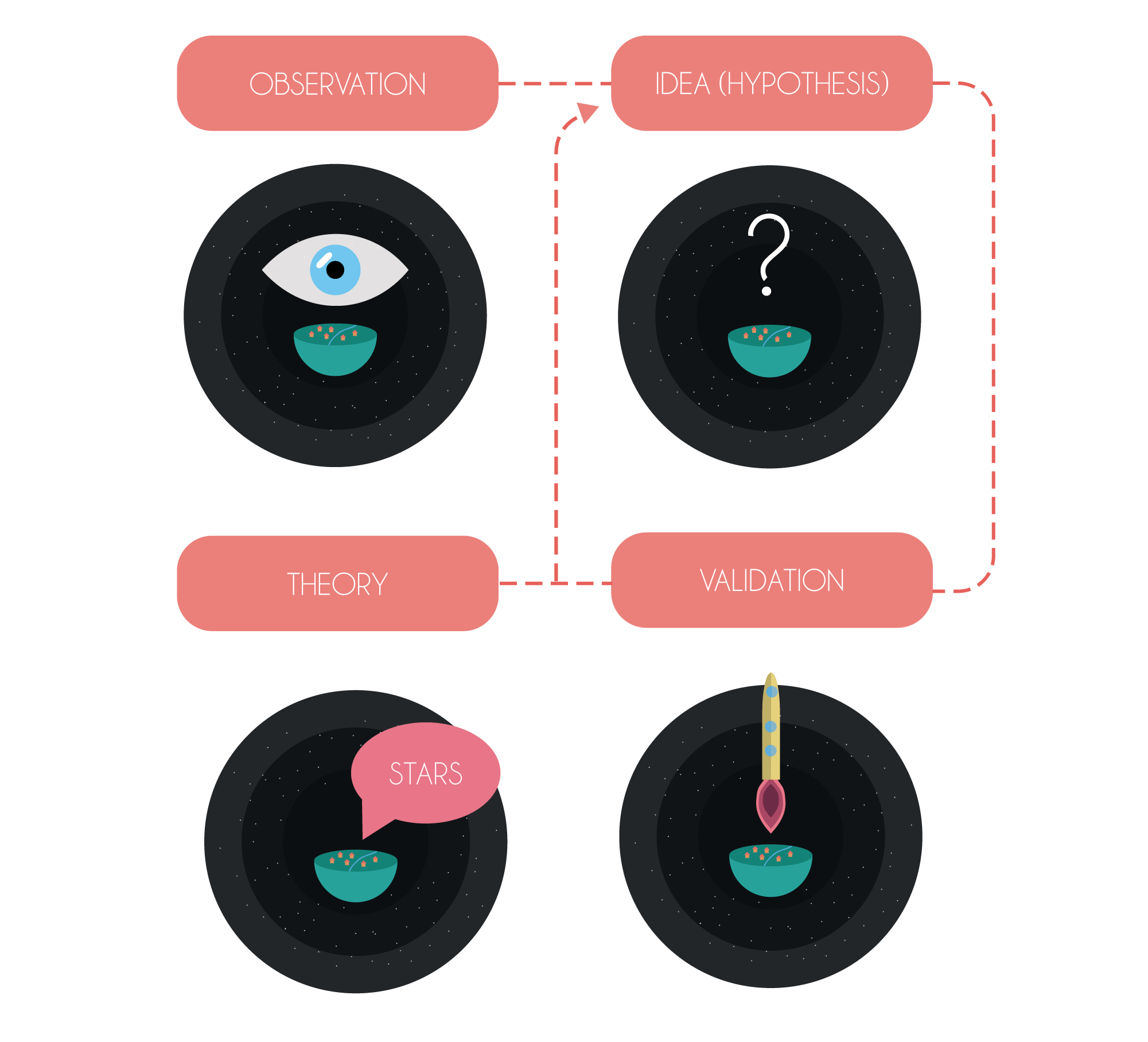
Even though we do not know the answer to this great question, there are certain things we do know about the evolution of the cosmos. Or – to be scientifically accurate – there are some things that we suspect. The essence of science is trying to understand the world around us as well as we can. We may achieve that by constructing hypotheses and authenticating them using the scientific method.
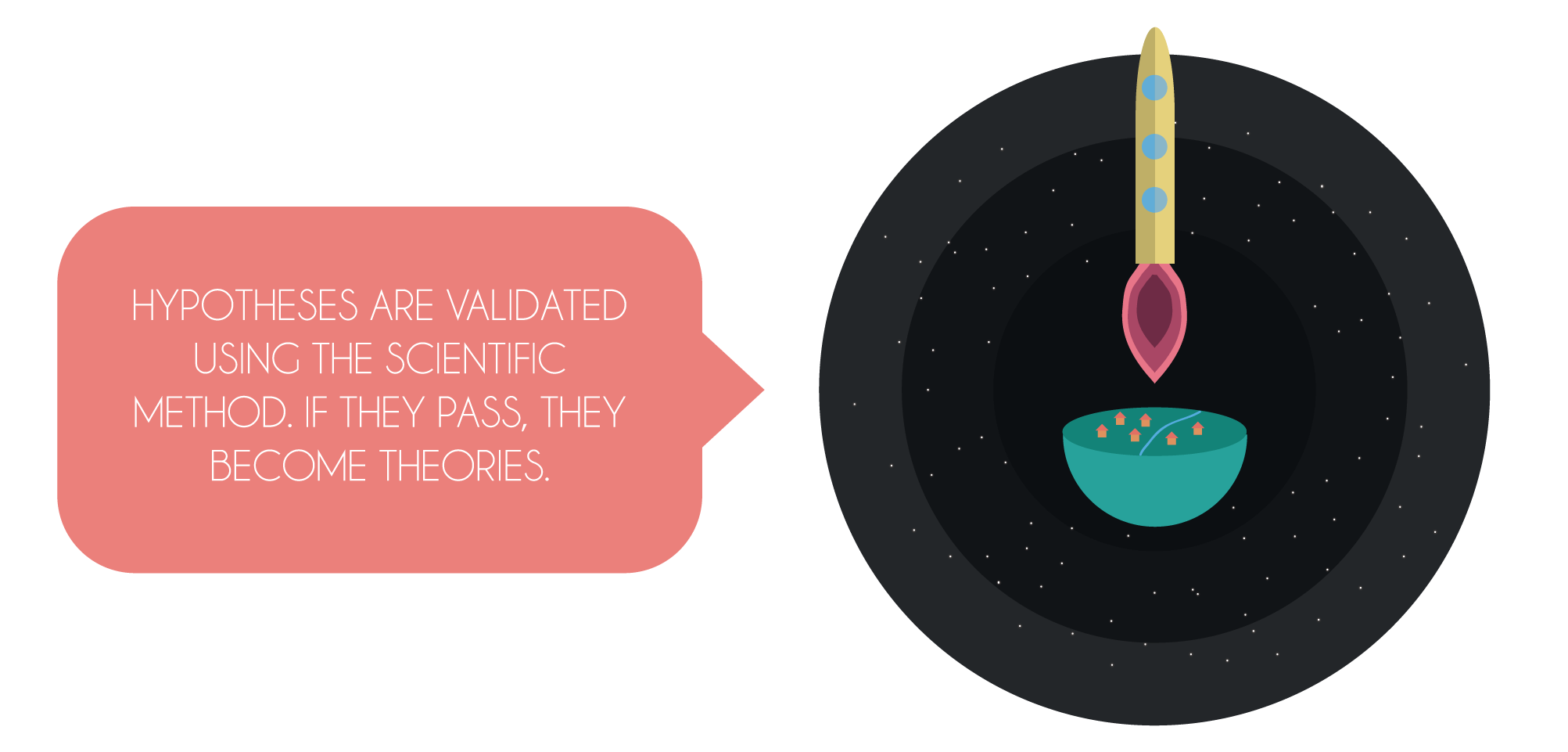
Anybody can devise a hypothesis. We can construct a simple thought experiment as an example – a prehistoric man sees strange dots in the night sky (today known as stars) and draws a conclusion that somebody must have painted them on the firmament – he has just created a hypothesis. To check the hypothesis, the prehistoric man builds a rocket (let us neglect the fact that the technical advancement of prehistoric people, whose apogee is knowing how to make fire, is nowhere near the level necessary to construct something as immensely sophisticated as a rocket) and sends this rocket far away, so that it can meet those mesmerizing dots – he is authenticating his hypothesis using the scientific method. Much to his dismay, the rocket is serenely wandering through space with no firmament in sight. His hypothesis has just been disproved.
However, if a hypothesis does pass all trials we impose on it, it is promoted to a theory. Now, we are finally talking about science, which is – in its purest form – a simple collection of such theories. Whether we are dealing with physics, psychology, biology, chemistry or astronomy, this element is common for all sciences. The entire human knowledge is just a large pile of theories, which are categorized into individual branches of science.
But there is another very important factor at play – some people consider theories an absolute, unshakeable truth. This view is incorrect. Science perceives theories merely as a collection of fragments, each of them trying to describe a tiny piece of reality. Some fragments are very precise, others not so much. If a theory is found insufficiently accurate, scientists are immediately ready to replace it with a different, better one. A good example is the multitude of theories which are trying to describe one of the most common phenomena in the universe – gravity. For many years, the best description of this mysterious entity by far was provided by Newton’s theory of gravity. However, it has been found somewhat inaccurate in some extreme cases. Eventually, it has been overthrown by Einstein’s general theory of relativity.
However, it was not such a long time ago that scientists realised that even general relativity is not perfect – it is not able to describe the gravitational interaction at the submicroscopic level. Unfortunately, no valid alternative has been found yet and general relativity is still awaiting its successor.
This example shows us the cruel truth about science – we can never be sure of anything. Even though we might think that we have revealed some tiny piece of reality, there is always a possibility that we have neglected a certain aspect of the cosmos in one of our theories, and thus something completely unexpected might happen. Who knows? Perhaps there is a space constant – whose existence is hidden from us – which will annihilate all of us. Perhaps the universe will die today.
There is nothing to worry about though. It is pointless to think about such things, since we are again finding ourselves in the treacherous world of hypotheses. Let us go back into the scientific world of theories, which still provides by far the best description of reality – despite its potential drawbacks. Specifically, let us devote our attention to a great theory that provides the best summary of everything we suspect about the creation of the universe itself – the Big Bang theory.
0️⃣ Wake Up Before 5.30 AM 7️⃣ Clock In Before 9.00 AM 3️⃣ Money Manager 1️⃣7️⃣ Shalat / Quran 5️⃣ Vocabulary / Tutorials 1️⃣3️⃣ Blog / Instagram / LinkedIn 2️⃣1️⃣ Highlight / TikTok / Video 2️⃣ Chores / Personal Care / Favor 1️⃣0️⃣ Work / Commute / Go Outside (Hour) 0️⃣ Whatsapp / Discord / DM (Bubble) 0️⃣ Line of Code (Personal Project) 0️⃣ Read (Paragraph / Manga Chapter) 0️⃣*️⃣🔟 Art / Craft / Cuisine / Dessert
In 1995, scientists picked out a tiny section of the night sky — the amount that would be covered by a tennis ball 100 m above you — that was unusually devoid of stars. To the naked eye, and even in a normal telescope, this region looked empty and black.
The scientists used the Hubble Telescope to take a 10—day long exposure of the empty region to find out what was out there deep in the blackness. They came back with an astonishing photo of over 10,000 galaxies, each one perhaps containing 100 billion or more stars. All in a pinpoint little square of the night sky.
Scientists used the info from this photo to postulate that the observable Universe contains over 100 billion galaxies. Today, that galaxy estimate has risen by 20 fold to 2 trillion, and it may continue to rise as we learn more. That suggests the total stars in the observable Universe to be somewhere between 10^33 and 10^25, or around 1 septillion stars.
To put that in perspective, people at the University of Hawaii spent an unreasonable amount of time calculating an estimate for the number of grains of sand on every beach in the world — 7.5 x 10^18 or 7.5 quintillion. That means that for every grain of sand on every beach on Earth, there are about 100,000 stars in the observable Universe.
1️⃣ Wake Up Before 5.30 AM 3️⃣ Clock In Before 9.00 AM 4️⃣ Money Manager 1️⃣7️⃣ Shalat / Quran 5️⃣ Vocabulary / Tutorials 1️⃣1️⃣ Blog / Instagram / LinkedIn 2️⃣7️⃣ Highlight / TikTok / Video 9️⃣ Chores / Personal Care / Favor 1️⃣1️⃣ Work / Commute / Go Outside (Hour) 0️⃣ Whatsapp / Discord / DM (Bubble) 0️⃣ Line of Code (Personal Project) 0️⃣ Read (Paragraph / Manga Chapter) 0️⃣*️⃣🔟 Art / Craft / Cuisine / Dessert






 Keishinrei