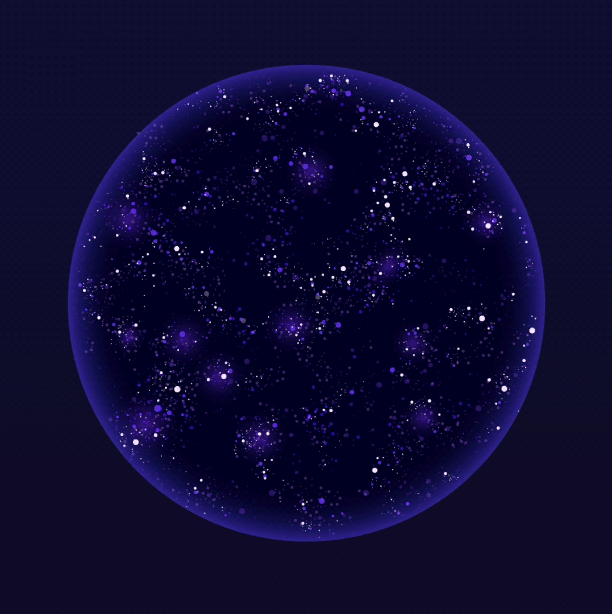
“The Great Nothing” is an enormous sphere in the Universe famous for containing a very sparse number of galaxies — space’s version of the Australian Outback.
No one knows for sure why the Great Nothing exists. The most fun (totally unfounded) hypothesis is that perhaps the void is created by an expanding Kardashev III scale civilization that has been around long enough to conquer a major region of the Universe and capture the energy of its galaxies.
If the observable Universe is our world, the Local Group of galaxies our neighborhood, the Virgo Supercluster our city, and the Milky Way our house, the Pisces Cetus Supercluster Complex is our country. The PCSC is a “galaxy filament” — a cluster of galaxy superclusters — and the largest known structure in the Universe. The PCSC, our home filament, is one billion light years across, and it’s thought to contain mass equivalent to 10^18 Suns. Our “city”, the Virgo Supercluster, only comprises 0.1% of the PCSC’s total mass.
A “cold spot” in the direction of the constellation Eridanus has led to speculation that it may be a space void one billion light years across – so vast it would be 1,000 times larger in volume than the Great Nothing. The loneliest place in the Universe.
A “Great Wall” is a type of galaxy filament – a cluster of galaxy superclusters – in the rough shape of a wall. The Sloan Great Wall, about a billion light years from us, is one of the biggest filaments we’ve discovered, with a length of 1.37 billion light years. That’s the equivalent of about 7,000 Milky Ways lined up next to each other.
A parsec is a length unit used to measure the huge distances of astronomical objects outside the Solar System. A billion parsecs, or about 3.3 billion light years, are called a gigaparsec. Until we discover a multiverse, this is the largest unit of length measurement we’ll ever need. A gigaparsec makes the observable Universe seem quaint, as it stretches only about 28 gigaparsecs across, or about 14,000 cubic gigaparsecs in volume.
Galaxy filaments are clusters of galaxy superclusters, which makes them the largest known structures in the Universe. The appropriately—named Hercules Corona Borealis Great Wall is the largest known galaxy filament — making it the largest known structure in existence.
Galaxy filaments are kind of like the Universe’s countries. If our home country, the Pisces Cetus Supercluster Complex, is the size of Germany, the Hercules Corona Borealis Great Wall is around the size of Russia. An outrageous 10 billion light years across, the HCB Great Wall stretches over a tenth of the way across the observable Universe!
In 1995, scientists picked out a tiny section of the night sky — the amount that would be covered by a tennis ball 100 m above you — that was unusually devoid of stars. To the naked eye, and even in a normal telescope, this region looked empty and black.
The scientists used the Hubble Telescope to take a 10—day long exposure of the empty region to find out what was out there deep in the blackness. They came back with an astonishing photo of over 10,000 galaxies, each one perhaps containing 100 billion or more stars. All in a pinpoint little square of the night sky.
Scientists used the info from this photo to postulate that the observable Universe contains over 100 billion galaxies. Today, that galaxy estimate has risen by 20 fold to 2 trillion, and it may continue to rise as we learn more. That suggests the total stars in the observable Universe to be somewhere between 10^33 and 10^25, or around 1 septillion stars.
To put that in perspective, people at the University of Hawaii spent an unreasonable amount of time calculating an estimate for the number of grains of sand on every beach in the world — 7.5 x 10^18 or 7.5 quintillion. That means that for every grain of sand on every beach on Earth, there are about 100,000 stars in the observable Universe.
The age of the Universe and the speed of light combine to limit our vision to a 93-billion-light-year spherical bubble of what may be a far greater place. We hope that one day we can learn what else is out there beyond our bubble. Until then, there should be enough going on in the observable Universe to keep us busy: at least 2 trillion galaxies and a septillion stars.
If the observable Universe were a sphere 1 km across, so it would stretch a bit higher than the tallest skyscrapers, our Milky Way would be a tiny disk 2 mm across. On that scale, our Sun is the size of a proton, orbited by a subatomic rocky planet, where the neutrino—size primate reading this is capable of imagining the sheer wonder of it all.


 Keishinrei