History of Our Cosmos – The Evolution of Matter

Every single object you see around you is made up of various atoms – tiny grains of matter. The human body, for instance, is composed predominantly from oxygen, carbon, hydrogen and nitrogen atoms. However, all atoms consist of even smaller grains – protons, neutrons and electrons. The number of protons inside an atom determines what kind of atom (or chemical element) we are dealing with. If you see an atom with only one proton in its core, it is surely hydrogen. If you encounter an atom with two protons, you are without any doubt dealing with a helium atom. Six protons? Carbon. Eight? Oxygen. We could go like this all the way to the number 92 – the number of protons in uranium, which is the heaviest natural element of the universe.
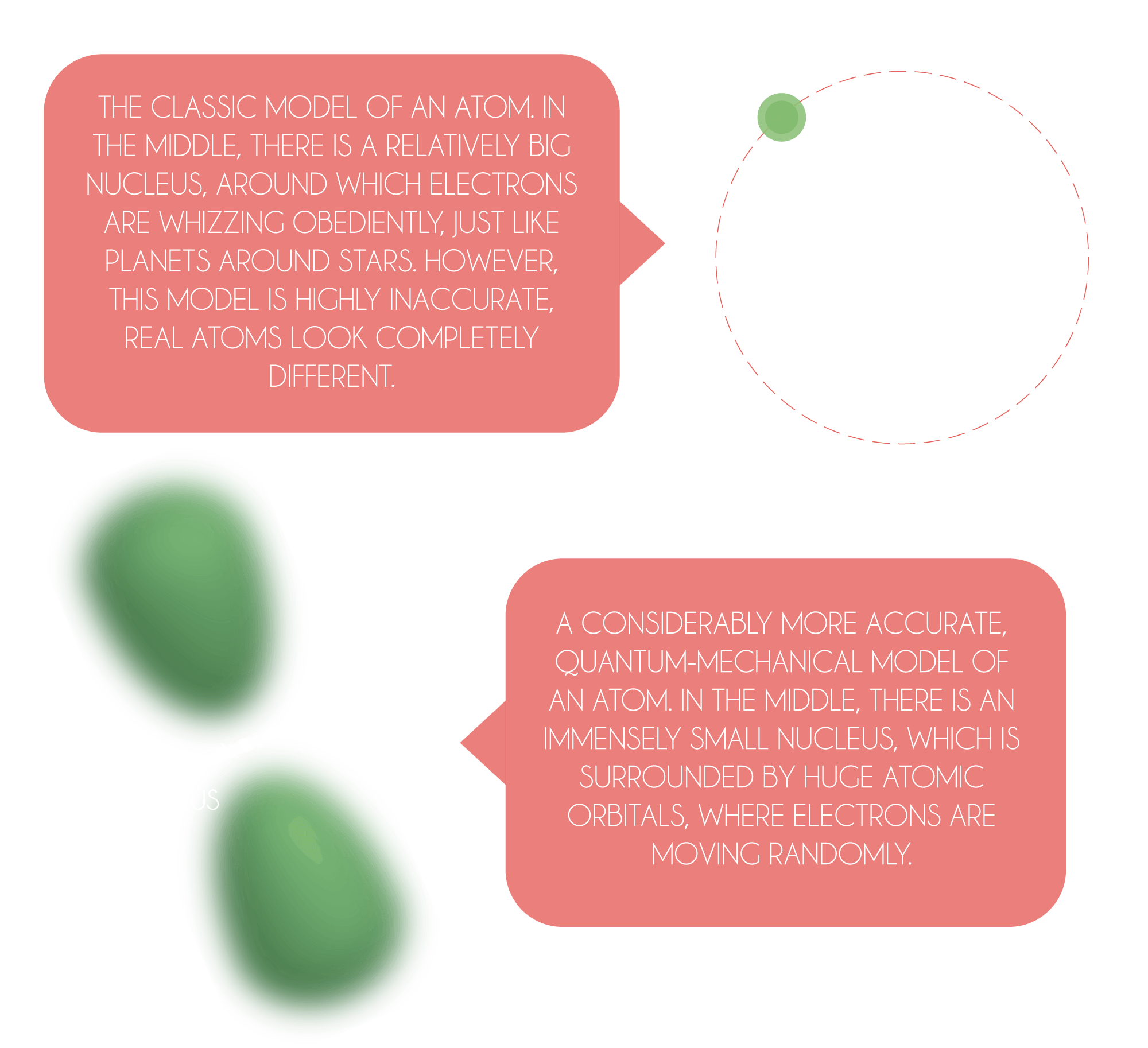
Your own atoms make up almost your entire mass. Every time you step on a scale, you measure the collective mass of all tangible subatomic particles that inhabit your body. But there is one important question – where do all of these particles come from?

To comprehend the sudden appearance of matter in the early cosmos, we first need to focus on the most famous physical equation on the planet, whose author is a world-renowned physicist Albert Einstein. E = mc2. Energy is equal to mass times the speed of light squared. Nice, you might say, but what exactly does it mean? Simply said, this brief equation daringly states that energy and mass are nearly the same thing. The only “converter” between the two quantities is the speed of light squared.

Take any object and multiply its mass by approximately 90 million billion – the value of the speed of light in meters per second squared. If you do that, you discover the immense amount of energy hidden inside the object. And you can do it in reverse too – if you take an arbitrary amount of energy and divide it by 90 million billion, you get its mass.

Exactly. Every form of energy weights something. A hot cup of tea is heavier than a cold one, as it contains more heat energy. However, you do not need to experiment and try to verify this fact by carefully weighing various tea cups at different temperatures – that is unless you live in a distant future where humanity is so technologically advanced that it can manufacture a hugely impressive scale which is able to detect differences of about a millionth of a millionth of a gram. Heat energy is far less concentrated than the energy we can find in matter. You would need to heat your cup to millions of degrees for a perceptible difference to appear.

The previous paragraphs could be summarised into one sentence – energy and matter are very closely related. So related, in fact, that you can create one out of the other. How? Well, if we consider the fact that each tiny bit of matter contains an enormous amount of concentrated energy, it would be logical to focus an unimaginable volume of energy to a single spot and hope that all of this energy would somehow “unite” and create a tangible particle. However, it is incredibly difficult to achieve that in today’s universe.

But if we consider how much condensed energy the early universe contained during the cosmic inflation (its temperature reached impressive billion billion degrees Celsius), we get stunning conditions for the creation of matter. The energy of the early cosmos was simply so concentrated that tangible particles started spontaneously forming.

The formation of matter definitely did not take long though – all of it was created during the unbelievably quick cosmic inflation. At its end, the universe contained nearly all the matter you can see around you. Every single one of billions of stars and galaxies consists of the same matter that was created just a fraction of a second after the Big Bing, when the universe was about the size of a grape.
Back then, however, matter was far from forming atoms. For those, we have to wait several hundred thousand years. At that time, all matter was represented by the simplest of particles called quarks and leptons.

But there is a catch – the formation of matter is not that simple. There is a rule that with each particle of matter, its counterpart in the form of antimatter has to be created. Antimatter is just like normal matter, except that some of its properties are opposite – electric charge, colour or flavour. (The last two properties have obviously nothing to do with “our classical” flavour and colour – elementary particles cannot actually have any colour, since they are much smaller than the wavelength of visible light, not to mention flavour. They are just names physicists have given to various types of charges.)

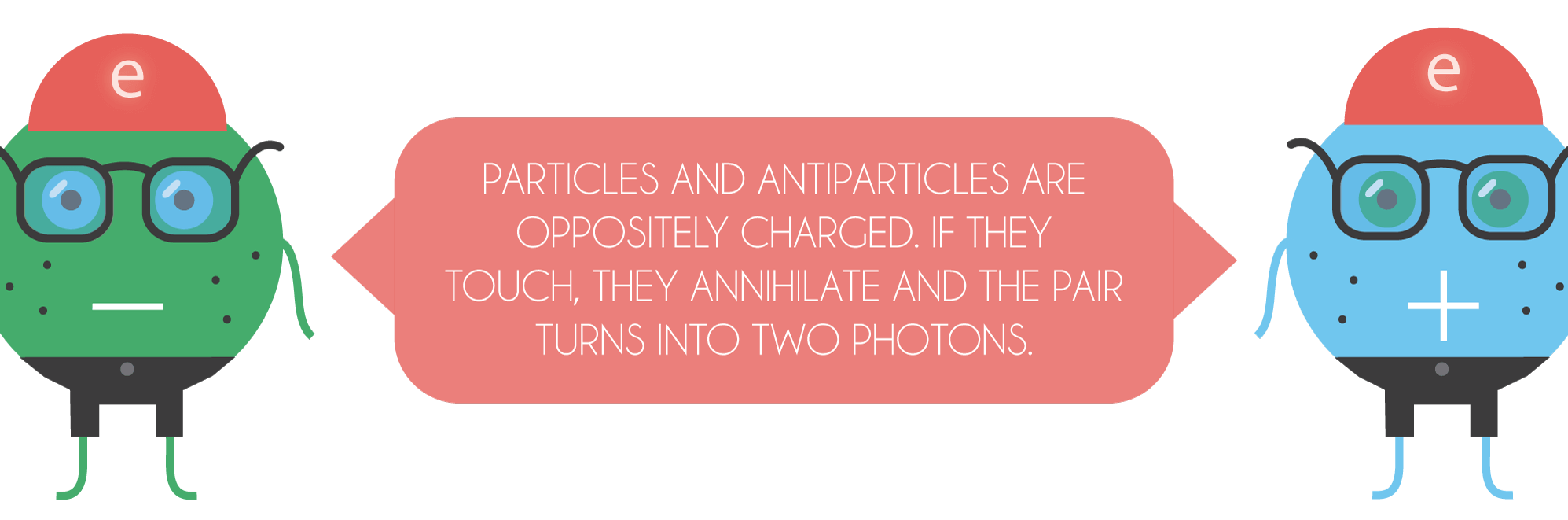
But what is more interesting – matter and antimatter cannot stand each other. If they come into contact, both of them are destroyed in a violent explosion (this process is called annihilation) and all of their energy is transformed into photons – the particles of light.
Let us go back to the creation of matter in the early cosmos. It follows from the previous paragraphs that all the matter which was produced just a moment after the Big Bang had to be accompanied by the same amount of antimatter – each tangible particle was created along with its antiparticle. And since the universe was so incredibly small back then, the contact of particles and antiparticles was simply inevitable. Most of the newly created tangible particles crashed into an antiparticle and perished just a moment after their birth.

But there is one significant question. Why is there still matter in the universe today? By the laws of physics, the exact same amount of matter and antimatter should have been created. Theoretically, it follows that mutual destruction of all matter and antimatter should have occurred in the young universe. But that did not happen – otherwise we would not be here.

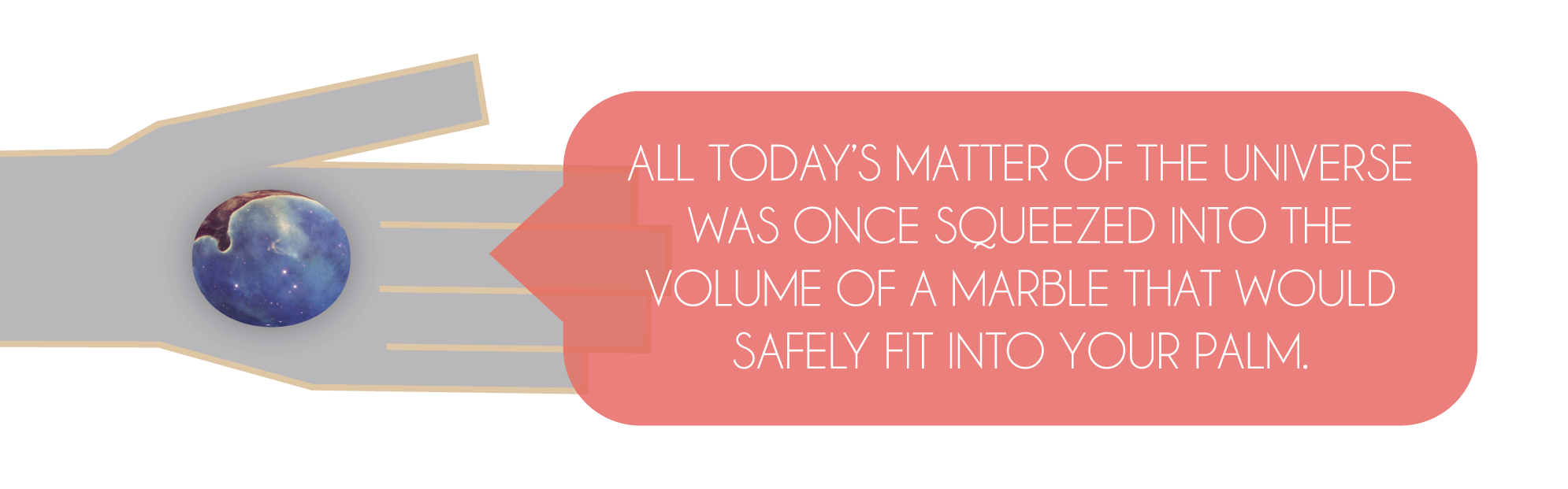
Nobody knows why, but it seems that for every several million antiparticles, one extra particle was created. Each of these surplus particles avoided annihilation and formed all matter we can see in today’s universe. It is staggering when we realize that the early universe not only contained nearly all matter it does today, it contained much more of it. And all of that was squeezed into a volume that would fit into a human palm.

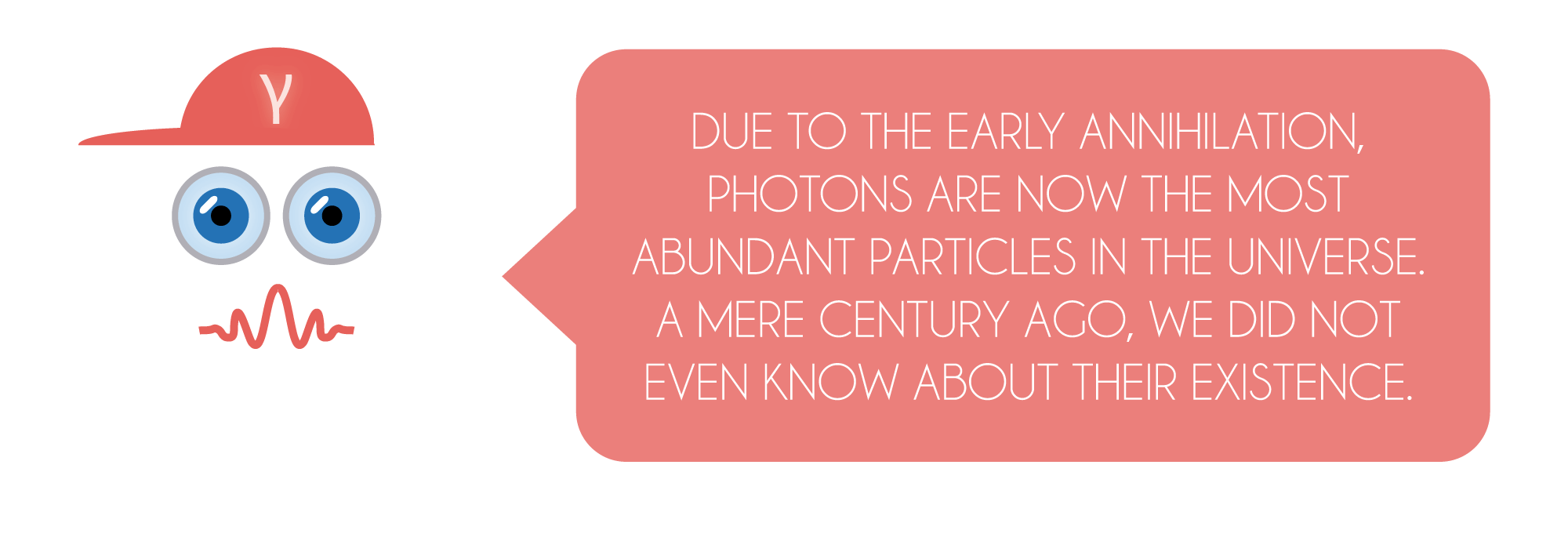
However, the energy released in matter-antimatter collisions did not disappear. It was transformed into photons of high-frequency radiation. These photons then kept on roaming the newly created universe, which was packed with charged tangible particles. These particles prevented the photons from moving freely. It took 380 000 years before the universe became transparent due to the formation of atoms and photons were finally able to travel unimpeded. Many of these photons keep on cruising the universe to this very day and constitute the cosmic microwave background – living evidence of the Big Bang.
Length of All Human DNA Combined

18,819,542 LIGHT YEARS

The Local Group is our pocket of the Universe, the limit we will never cross. But if we took the DNA of all the humans present on Earth in 2021, untangled and put these strands together into one long ribbon, it would span one and a half times across the Local Group. Bunched up tightly together, our species’ collective DNA could fill a cube with sides the length of a football field.

Fornax Cluster

33,700,000 LIGHT YEARS

Clusters are families of entire galaxies, that unlike real families aren’t bound together by blood, petty feuds and love, but gravity. They contain enough matter to pull even distant family members toward them — again, with gravity, not a bad conscience and wedding ceremonies like real families do. Hanging out 60 million light years away, you could call this cluster of galaxies the next neighborhood over from ours.

Virgo Supercluster

144 MILLION LIGHT YEARS

If the observable Universe is our world, the Local Group of galaxies our neighborhood, and the Milky Way our house, the Virgo Supercluster is our city. The “city” has more than 700 galaxies in 100 Local Group “neighborhoods”, and stretches 110 million light years across. To put that in perspective, if the observable Universe is a sphere with a diameter of 1 km, large enough to contain the tallest skyscrapers, the Virgo Supercluster is a sphere 1.47 m across, about the height of a child. On that scale, the Milky Way is a tiny disk 2 mm across.

Distance to the Great Attractor

220 MILLION LIGHT YEARS

Space looks calm, but actually our own galaxy, the Milky Way, is traveling through the cosmos at 2.2 million km an hour. This is a bit of a mystery. According to our ideas about the Big Bang, everything in the Universe should be flying apart at similar speeds. If everything is moving at similar speeds, it should look like nothing is really moving at all. When some objects seem to be moving faster than others, it’s usually because clumps of matter like galaxy clusters are exerting an additional gravitational pull. But we know of nothing close to the Milky Way that explains its drift — we just know that something must be causing it. Astronomers named the mysterious clump of matter we haven’t found yet “The Great Attractor”.

The Great Nothing

330 MILLION LIGHT YEARS

“The Great Nothing” is an enormous sphere in the Universe famous for containing a very sparse number of galaxies — space’s version of the Australian Outback.

No one knows for sure why the Great Nothing exists. The most fun (totally unfounded) hypothesis is that perhaps the void is created by an expanding Kardashev III scale civilization that has been around long enough to conquer a major region of the Universe and capture the energy of its galaxies.

Pisces Cetus Supercluster Complex

1 BILLION LIGHT YEARS

If the observable Universe is our world, the Local Group of galaxies our neighborhood, the Virgo Supercluster our city, and the Milky Way our house, the Pisces Cetus Supercluster Complex is our country. The PCSC is a “galaxy filament” — a cluster of galaxy superclusters — and the largest known structure in the Universe. The PCSC, our home filament, is one billion light years across, and it’s thought to contain mass equivalent to 10^18 Suns. Our “city”, the Virgo Supercluster, only comprises 0.1% of the PCSC’s total mass.

History of Our Cosmos – The Beginning of Everything

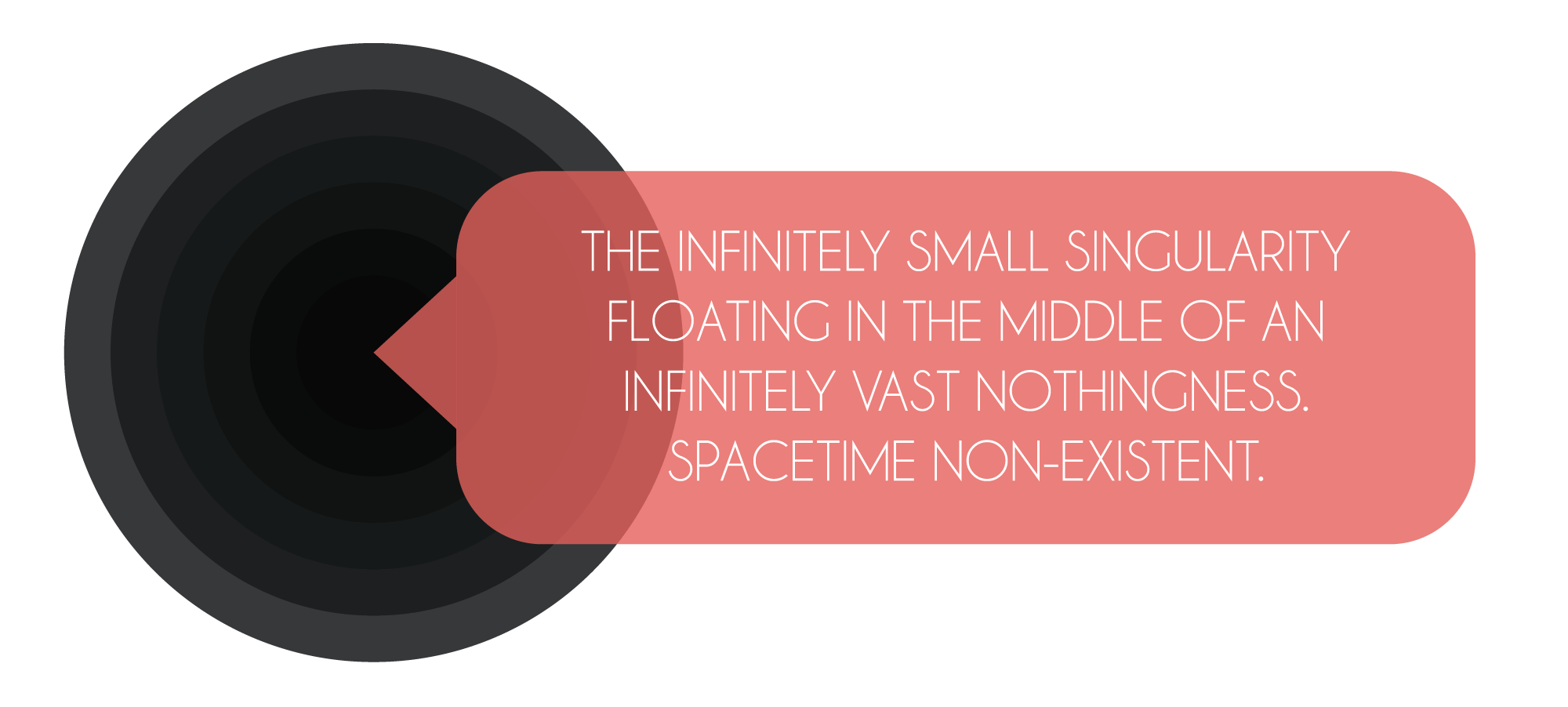
At the very beginning, there was a peculiar object called the singularity, floating in nothingness. How did it get there? That is a mystery. However, before we start exploring this immensely interesting object, we should focus on a different, seemingly trivial expression – nothingness.

Some might think that all the “empty” space around us could be considered nothingness. But that can hardly be the case, given that each centimetre of air contains billions of atoms.

Others might argue that the vacuum of space could be classified as nothingness. After all, vacuum is empty by definition – it contains no matter whatsoever. But there is a catch – vacuum is inside the universe just like everything else around us. And the universe is interwoven with space-time filaments. But space-time certainly is something. It is a specific area where all the laws of our universe are in effect.

For this reason alone, one cannot consider vacuum as complete nothingness, not to mention the immense amount of particles that are being created each second in every single tiny bit of vacuum as a result of quantum mechanics.

But the nothingness around our initial singularity was special and unique – time and space were non-existent and the laws of physics powerless. We would never be able to find such nothingness in our cosmos.

Back to our singularity. It would be fitting to say that it was an exceptionally peculiar object. We do not get to see such objects every day – never, in fact (unless we find ourselves in the centre of a black hole, which would probably not be an unduly pleasant experience – we are going to look into that in one of the following chapters).

Why was the initial singularity so peculiar? First of all, it may have been infinitely small, which is more than remarkable. On top of that, it was infinitely dense and infinitely hot, which makes good sense given that the entire universe had to fit into its heart. Exactly – everything you see around you has once been squeezed into this ancient singularity, though in a somewhat different form.

Suddenly, something incredible happened. Something that may be considered the strangest and most mysterious event of all time. The singularity started rapidly expanding and created the entire unbelievably huge universe. This incident is known under the majestic name of the Big Bang. However, it is rather ironic that we are using this name. First of all, this expression was coined by a man named Fred Hoyle, who was a tremendous opponent of the Big Bang theory (he favoured the competing Steady State theory). He only used this expression to mock the theory. In addition, the term “Big Bang” is incredibly inaccurate – it is far from representing the event that actually occurred.

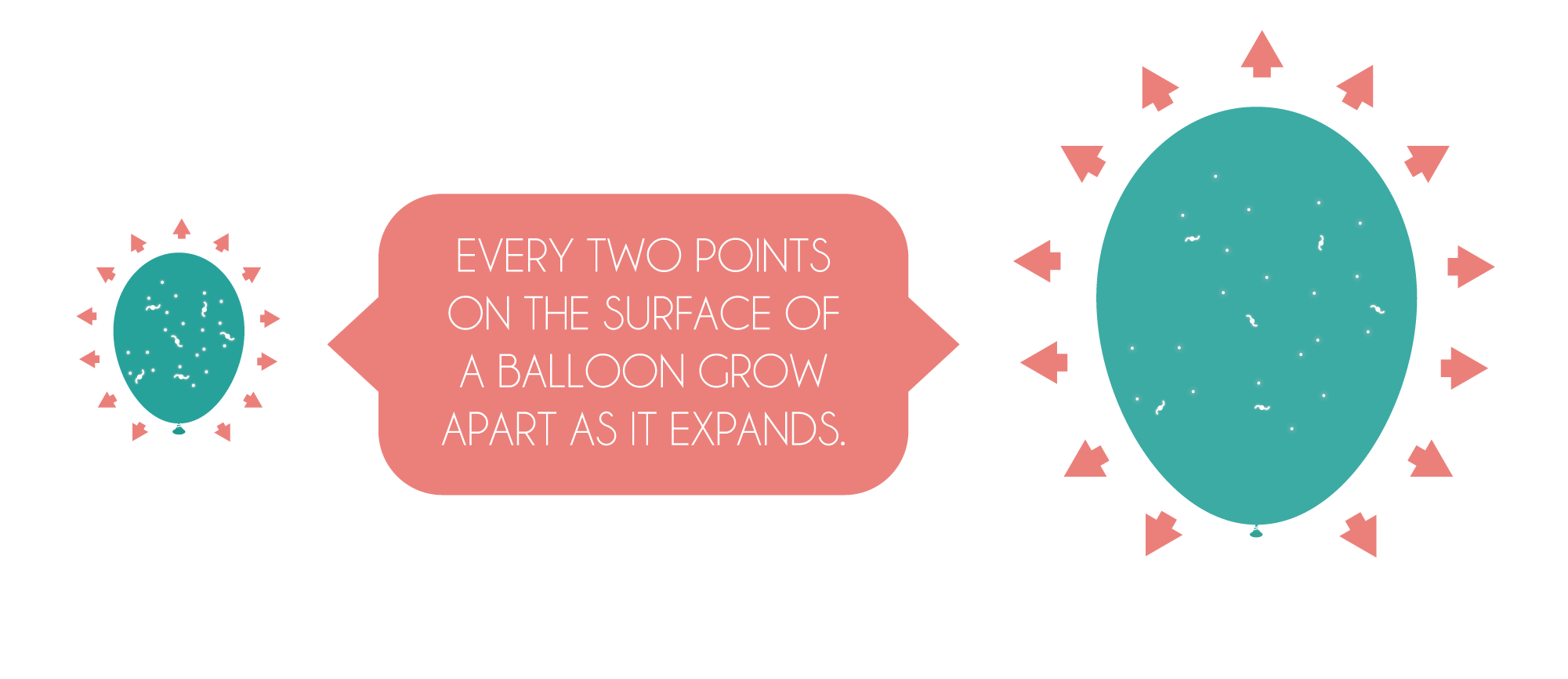
Let us focus on the word Bang first. This word seems to represent a grand explosion accompanied by stunning sound effects. Much to the dismay of action movie fans, the actual “Big Bang” could be considered the exact opposite of such an explosion. There is no sound in vacuum, so let us forget about amazing sound effects. But more importantly, the Big Bang was not an explosion at all – it was more like an inflation of space (incredibly fast inflation indeed).

A great parallel is the inflation of a balloon. Imagine that our universe is represented by the surface of a balloon. If we inflate it, the distance between any two points on its surface increases. This is what the Big Bang and the following expansion of space looked like – it started off as an infinitely small point in the form of a singularity, and ended up as the surface of a gigantic “space balloon”. (Except that the surface of a balloon is a two-dimensional space curved in a third dimension, while our own universe is most likely a three-dimensional space curved in a fourth dimension. However, our primitive three-dimensional brains are not capable of imagining fourth-dimensional space – that is why we are using a simple balloon analogy.)

Now that we grasp the issues with the word Bang, let us focus our attention on the word Big. While the word Bang is utterly inaccurate, the word Big is correct. However, it is a tremendous understatement. The Big Bang was not only big, it was everywhere – every single tiny bit of space used to be condensed in an infinitely small singularity and underwent a whopping expansion. To augment our balloon metaphor, imagine that you are a two-dimensional ant inhabiting the surface of the expanding balloon. For such an ant, the surface of the balloon is the only thing in existence – the ant cannot escape it on its own. From its point of view, everything is inflating. For the sake of accuracy, it would be appropriate to replace the word Big with the word Huge – or even better, Omnipresent.

However, if we put these two accurate expressions together, we get something like the Omnipresent Inflation, which, let us admit, does not sound nearly as good as the Big Bang. We will therefore stick with the usual term, now with the knowledge of its imperfections.

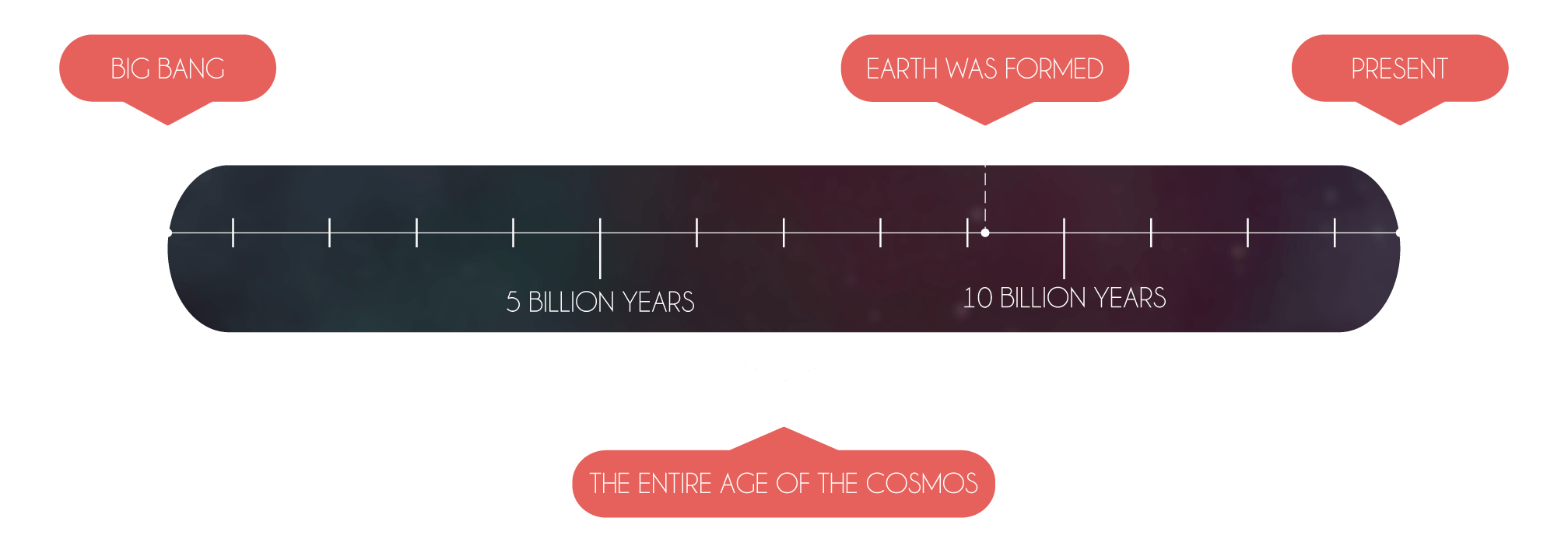
One of the greatest questions is when exactly the Big Bang occurred. This immensely interesting question has been subject to discussion for decades. Today, it is assumed that the singularity started expanding astounding 13.8 billion years ago. You do not even have to try to understand how long ago it was – for the human brain, it is practically impossible. But we can at least try to present this information in a different way – imagine that you put marbles one centimetre (0.4 inches) in diameter next to each other into a single row. If each marble represented one year of the universe’s existence, your row of marbles would go around the entire Earth. Three times. And if you by any chance wanted to live through the whole age of the universe, you would have to live incredible 200 million average human lives. For comparison, the Earth is about 4.6 billion years old – about 67 million lives.

Let us come back to the very beginning now. No one really knows why the Big Bang occurred, but we do know quite well how exactly this process took place. 13.8 billion years ago, the singularity, containing the entire energy of the cosmos, started rapidly expanding. This moment is considered to be the beginning of space-time as well as the universe itself.

But what happened before the Big Bang? This seemingly interesting question is actually pointless. Time is inherently woven into the structure of our universe. Before the Big Bang, it simply did not exist. Asking this question is like wondering about what is located north of the North Pole.

As you have surely already understood, most things about the singularity are extreme and unimaginable. And the super-rapid expansion of the early cosmos right after the Big Bang is surely no exception. Trying to imagine any of the numbers bellow is simply impossible.

About a billionth of a billionth of a billionth of a second after the Big Bang, the universe entered a monumental state known as the cosmic inflation. It should be noted that the temperature of the cosmos at that time was respectable 100 million million million million degrees Celsius! During the cosmic inflation, the universe increased its size in an unimaginable manner. From the initial size of less than a billionth the size of a proton, it inflated to a comparatively huge sphere 1 centimetre (0.4 inches) in diameter. But even more remarkable is the fact that it has managed to alter its size like this in a mere fraction of a second – the cosmic inflation started about 10-37 seconds after the Big Bang and ended somewhere between 10-35 seconds a 10-32 seconds after the birth of the cosmos.

And in a blink of an eye, the cosmic inflation was gone forever. Space-time continued on its expanding journey (in fact, it continues expanding to this day), but much more slowly. At the end of the inflation, the temperature of the universe was about a 100 thousand times smaller than at its beginning. It is mesmerizing that in a moment much shorter than anyone can even imagine, the universe changed so dramatically. But what is most important – once the cosmic inflation was over, the cosmos already contained a crucial component which makes our very existence possible – matter.

Sloan Great Wall

1.37 BILLION LIGHT YEARS

A “Great Wall” is a type of galaxy filament – a cluster of galaxy superclusters – in the rough shape of a wall. The Sloan Great Wall, about a billion light years from us, is one of the biggest filaments we’ve discovered, with a length of 1.37 billion light years. That’s the equivalent of about 7,000 Milky Ways lined up next to each other.