Omega Centauri is a vast “globular cluster”, a tightly grouped bunch of stars. 15,800 light years away and 150 light years across, Omega Centauri is the size of the full Moon in our night sky and can be seen in rural areas on clear nights. Containing 4 million solar masses, Omega Centauri is the largest, brightest, and most massive known globular cluster in the Milky Way. Some astronomers hypothesize that Omega Centauri is the remnant of a dwarf galaxy that merged with the Milky Way.
Messier 54 is a globular cluster astronomers originally thought was in the Milky Way. Then in the 1990s it come out that this whole time, Messier 54 has been in the Sagittarius Dwarf Elliptical Galaxy instead. Not really sure how you make that mistake.
Electromagnetism might be the best-known interaction to us. However, we mostly speak about two separate entities. First of them, electricity, is a force our entire modern society is based upon, since it propels possibly all modern devices, from the most primitive calculators to the fastest supercomputers. Without electricity, we would never have televisions, the internet, computers, and a lot more. There is no doubt that electricity is crucial for the proper functioning of today’s society. But what about the other of the two entities? Magnetism is mostly known for being an endearing force, due to which we can attach various objects to our fridges. But is electromagnetism really like that?
It turns out that electricity and magnetism are very closely related. So related, in fact, that one could not exist without the other. If you move an electrically charged particle (electron, for instance), a magnetic field is spontaneously formed around it. Conversely, anytime you move a magnet, an electric field is created. This phenomenon is exploited in power stations. Nearly all power stations are built on the principle of electromagnetic induction – a magnetic field is placed to the vicinity of an electrical conductor and spins perpetually (here, different types of power plants come into play – each type achieves the spinning of the magnetic field in a different way), which causes electric current to form in the conductor.
Just like gravity, electromagnetism has an infinite range. Unlike gravity, however, it does not affect every single object in the universe but only objects with electric charge (opposite charges attract each other, same charges repel). Nevertheless, electromagnetism can be observed all around us. Let us now describe individual manifestations of electromagnetism one by one. And we are going to start somewhat unexpectedly – with sight.
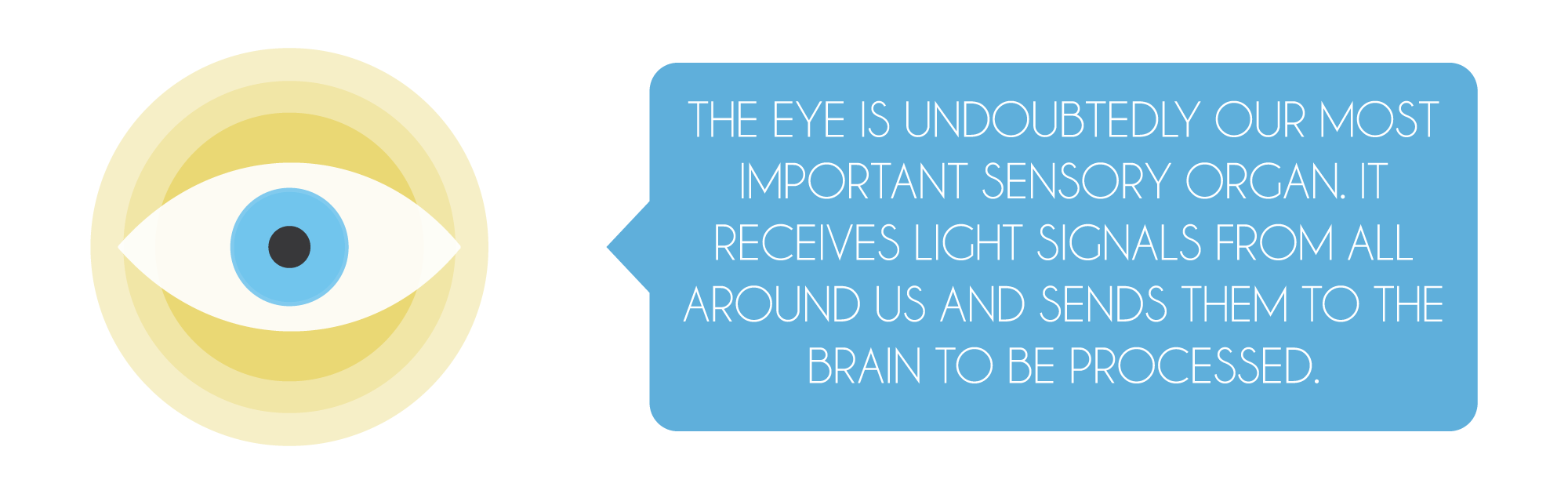
Sight is the most important of human senses. More than three quarters of all sensory perceptions our brain receives to process are provided by our eyes. Eyes that have been through hundreds of millions of years of evolution, so that they can function properly. All the various organs of sight, from the simplest of eyespots inside the bodies of minuscule organisms, to the most perfect eyes in the animal kingdom, have the same mission – to detect a specific part of the electromagnetic radiation which we like to call light.
As the name itself implies, electromagnetic radiation has something to do with electromagnetism. Its creation and propagation occur quite simply – a moving electric field generates a magnetic field, which in turn again generates an electric field, and so on. These repeating fields travel through space-time (at the speed of light, of course) until they reach an impediment that would absorb them.
For example, the electromagnetic radiation sent by the screen of the device on which you are reading these words travels into your eye, where it is absorbed and transformed into electric signals leading right to your brain. Once there, the signals are processed and consequently decoded as an image. If electricity and magnetism were not a conjoined entity, light would not be able to exist.
Now let us move to the subatomic level. Focus on any object in your field of vision. Positively charged protons attract the negatively charged electrons, which ensures the existence of the atoms your chosen object is made of. If we move a level up, we quite likely encounter molecules (collections of atoms) of the object. These molecules are formed due to diverse chemical bonds, which again are a manifestation of electromagnetism. In short, if this mesmerizing interaction ceased to exist, all objects around you – including yourself – would immediately break up into individual subatomic particles.
As we have just demonstrated, electromagnetism is, just like gravity, crucial for the existence of the cosmos as we know it. The manifestations of this interaction could be discussed much longer. However, we are going to move to the next, no less important force – the strong interaction.
The Great Nebula in Carina, formally called NGC 3372, lies in one of the brightest ports of the Milky Way. It boasts several massive stars and other nebulae — you know, the usual. The most energetic star within this nebula used to be the brightest star in the sky around 200 years ago — then it slowly faded. Take that as a lesson, kids, even interstellar fame isn’t forever.
Residing in the Large Magellanic Cloud, this giant spider is the largest known nebula — almost 10,000 times the length and a trillion times the volume of the smallest nebulae. If the Sun were the size of a grain of sand, and the largest stars were the size of cars, and the smallest nebula were 1.5 km wide, the Tarantula Nebula would be 10% bigger than the Earth! The nebula houses R136, the most productive star formation hotspot known in the Local Group of galaxies.
A couple of years ago astronomers had a riddle to solve. The theory of the Big Bang predicts that larger galaxies like the Milky Way are surrounded by a couple hundred dwarf galaxies — the galactic version of moons, orbiting Ground larger galaxies. But only a dozen have been discovered yet. One possible explanation is so-called “galactic cannibalism”. Larger galaxies have such intense gravitational fields that they suck up smaller surrounding galaxies, like the time the Milky Way ate the Sagittarius Dwarf Elliptical Galaxy for breakfast.
Recent analyses of the Leo 2 Dwaric galaxy indicate that it consists of older stars, suggesting that it somehow managed to go this whole time without being eaten by the Milky Way. This is kinda badass of it, since it is only 2,400 light years across, just a bit bigger than the largest nebulae. If the Milky Way were the size of a frisbee, Leo 2 would be a 3 mm pebble.
It’s funny to be an unthinkably vast galaxy and still be labeled as a dwarf. But it’s not unfair — while larger galaxies like ours have several hundred billions of stars, dwarfs have a humble few hundred millions of stars and they deserve the shade that comes their way.
The Small Magellanic Cloud is a small galaxy about 200,000 light years away that orbits our Milky Way like a moon. It is so bright that it can be seen with the naked eye, which makes it a great subject to study phenomena that are difficult to examine in more distant galaxies.
Gravity differs from the other interactions in multiple ways. First of all, it is by far the weakest of fundamental forces. In fact, we can simply demonstrate this fact. Try to lift an object using your hand. A pencil, a glass, anything. If you have succeeded and the object is safely in the air surrounded by your palm, congratulations – you have just managed to overcome the gravitational pull of the entire Earth, whose mass is in trillions of trillions of kilograms. How can gravity be the dominant force of the universe when it is so immensely weak?
The reason is that the other three interactions, though much stronger, simply are not customized to become the prevailing force of the universe. Strong and weak forces have a very short range – they only affect objects that are far less than a billionth of a meter apart. And the last interaction, electromagnetism, only influences objects with an electric charge. The problem is that you do not find such objects very often in the macroworld – most objects are neutrally charged. So the only reason that this ridiculously frail interaction has become the motive force of the cosmos is that it simply has no competition.
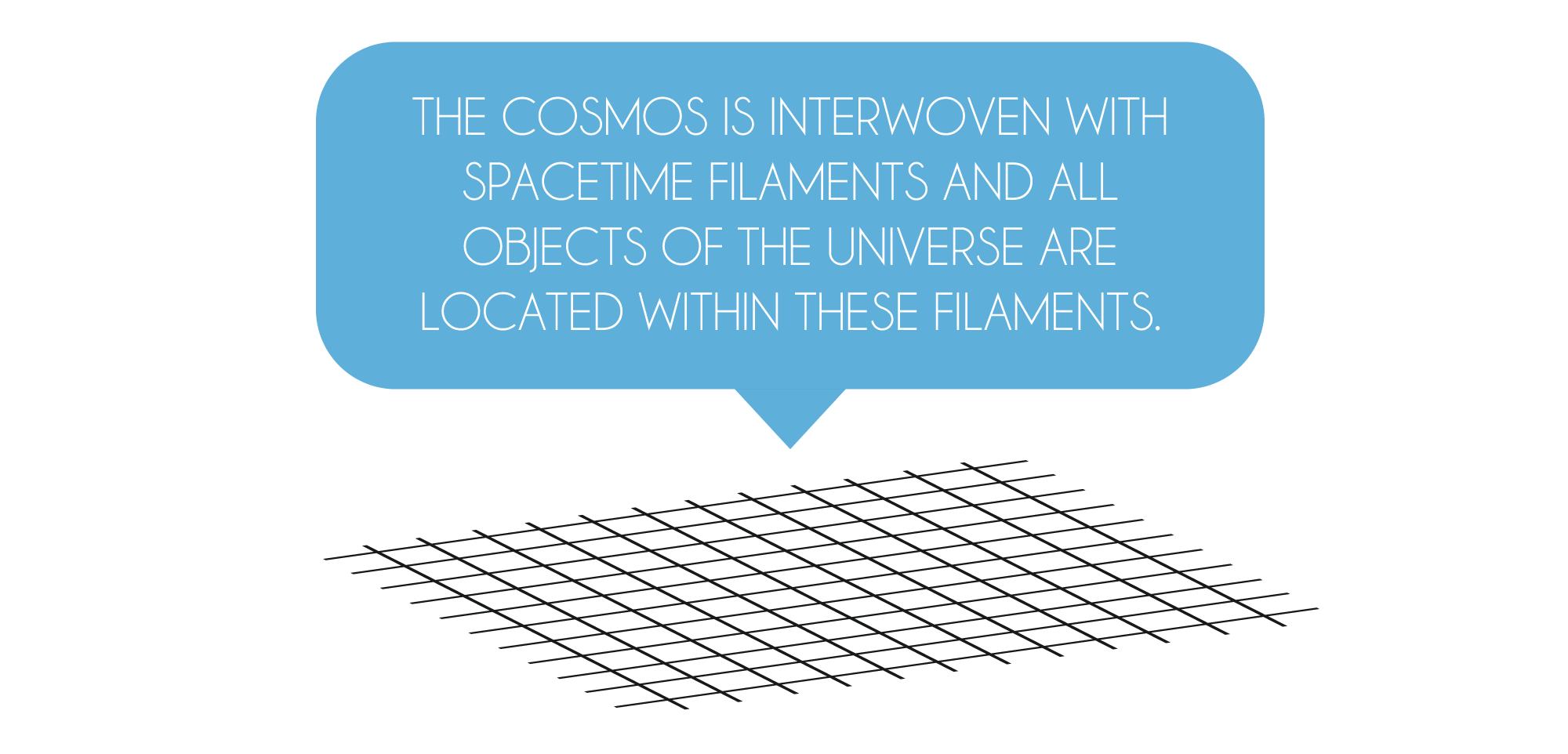
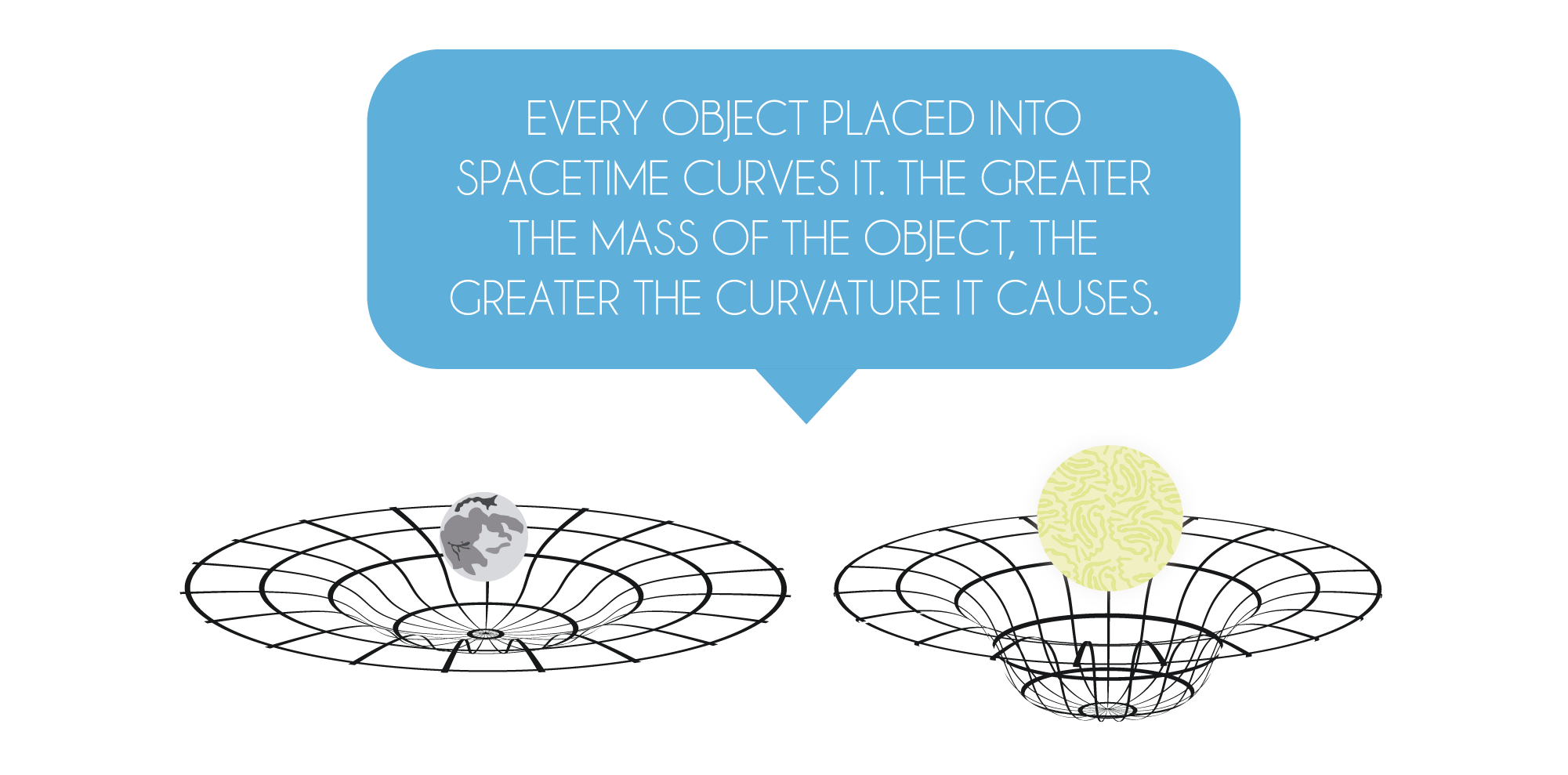
The second factor that makes gravity special is that it is presumably not really a force, even though it has been viewed as such to the beginning of the 20th century. However, with the advent of Einstein’s theory of relativity, our view of gravity has changed radically. Einstein saw gravity merely as a curvature of space-time. Every object in the universe simply creates a kind of dimple in the space-time continuum and all other objects are inclined to move closer to that object.
It is like placing a heavy object into the middle of a trampoline – the entire surface of the trampoline curves downwards, and if you place a different object near its rim, it starts to roll towards the original object. This analogy, however, has an imperfection. Just like with the inflation of the universe after the Big Bang, we need to take away one dimension to comprehend the phenomenon.
The surface of a trampoline can be perceived as two-dimensional space (it has width and height, but no depth) similarly to a sheet of paper. An object placed to its middle causes its two-dimensional space to curve. Therefore, the surface of a trampoline with an object in its centre can be understood as a two-dimensional space curved in the third dimension.
However, our universe is three-dimensional, so any curvature caused by the presence of an object in our space-time occurs in the fourth dimension. That is also the reason why we can never perceive any gravitational curvature. We would need to be four-dimensional beings for the curvature to be revealed to us.
However, it does not hurt to know that nobody is sure whether this theory of gravitational space-time curvature is true. With today’s technical advancement, we are struggling to find evidence that gravity indeed curves our three-dimensional space.
But there is another view of gravity, completely different from the one I have just described. According to this view, gravity is provided by a hypothetical particle called the graviton. How? Simply said, every two objects in the universe exchange various numbers of gravitons, which causes them to attract.
To understand why there are two different perceptions of gravity today, we first need to become acquainted with the greatest problem of today’s physics – the everlasting search for the theory of everything. To achieve that, we need to travel more than a hundred years to the past, to the beginning of the 20th century, where we will witness the birth of the two greatest physical theories of today.
By the end of the 19th century, some physicists presumed that physics was already complete. They thought that everything had already been described by the old physical theories. But then came the year 1900, along with a new revolutionary theory called quantum mechanics, which proved how immensely wrong those physicists were. This theory describes the behaviour of objects from the microworld, which is completely different form the behaviour of “normal” objects. Fifteen years later, classical physics was stabbed again by Einstein’s general theory of relativity, which utterly transformed our view of gravity and beautifully described the motion of objects at high velocities.
However, there is a tremendous problem with these two theories – each one seems to describe a completely different world. While quantum mechanics successfully uncovers the peculiarities of the microworld, general relativity brilliantly describes the motion of objects of the macroworld. But if we wish to fully comprehend our mysterious universe, we need to unify these two incompatible theories into one. Physicists have been trying to achieve that for the past hundred years, so far without much success.
And the problem with today’s view of gravity rises from here. While the description of the remaining three interactions comes from quantum mechanics, the best understanding of gravity is provided by general relativity. Physicists therefore aim to describe gravity within the framework of quantum mechanics, so that it forms a single integrated theory. This non-existent theory is called the theory of quantum gravity or simply the theory of everything.
And that is the reason why there are two different views of gravity today – one almost perfect in the framework of general relativity, which is not compatible with other interactions, the other not so perfect within quantum mechanics, which is crucial for the upcoming theory of everything, but includes these peculiar particles called gravitons, which have never been detected.
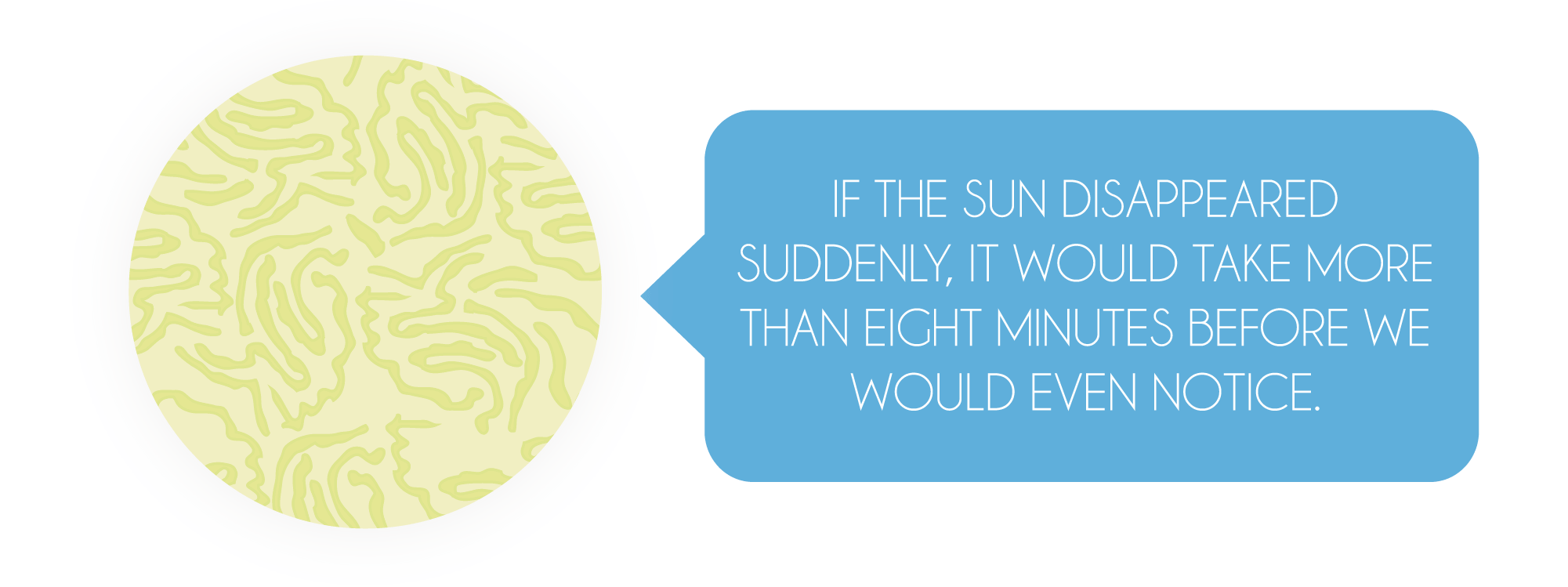
Not to worry though – luckily, there are a few things that we know about gravity with certainty. Firstly, gravity is always attractive. There is no instance of two objects gravitationally repulsing each other. Secondly, gravity propagates with the speed of light, which is the highest velocity anything can reach when traveling through space-time. That means that if the Sun were to disappear now and stop influencing us gravitationally, it would take exactly 8 minutes and 20 seconds for us to notice it and free ourselves from the Sun’s gravitational field (at the same time, the Sun would also disappear from the sky, as the last of its light would reach our planet). Until then, the Earth would keep revolving around the non-existent Sun.
And the third fascinating thing we know about gravity is that its range is infinite. Your own body attracts all the other objects from the observable universe – though it may seem peculiar, you are gravitationally attracting your computer, every single person on this planet, or the Andromeda galaxy, located several million light years away. It goes without saying that the gravitational interaction between you and the objects around you is absolutely negligible – gravity is simply too weak and its power starts showing only with overwhelmingly huge objects.



 Keishinrei