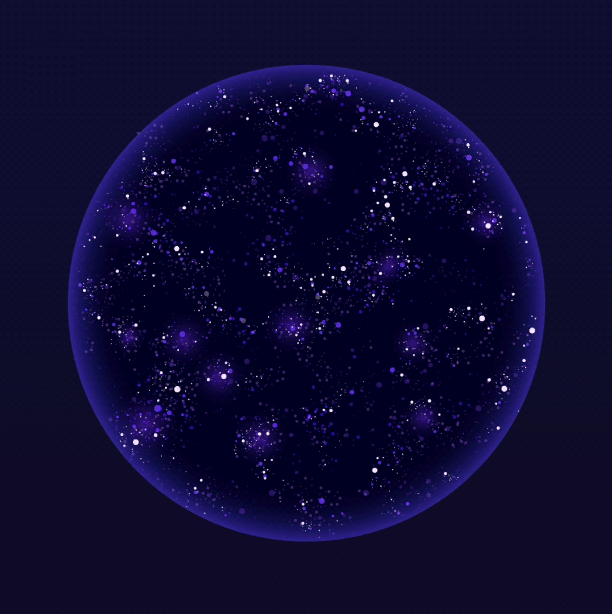
The age of the Universe and the speed of light combine to limit our vision to a 93-billion-light-year spherical bubble of what may be a far greater place. We hope that one day we can learn what else is out there beyond our bubble. Until then, there should be enough going on in the observable Universe to keep us busy: at least 2 trillion galaxies and a septillion stars.
If the observable Universe were a sphere 1 km across, so it would stretch a bit higher than the tallest skyscrapers, our Milky Way would be a tiny disk 2 mm across. On that scale, our Sun is the size of a proton, orbited by a subatomic rocky planet, where the neutrino—size primate reading this is capable of imagining the sheer wonder of it all.
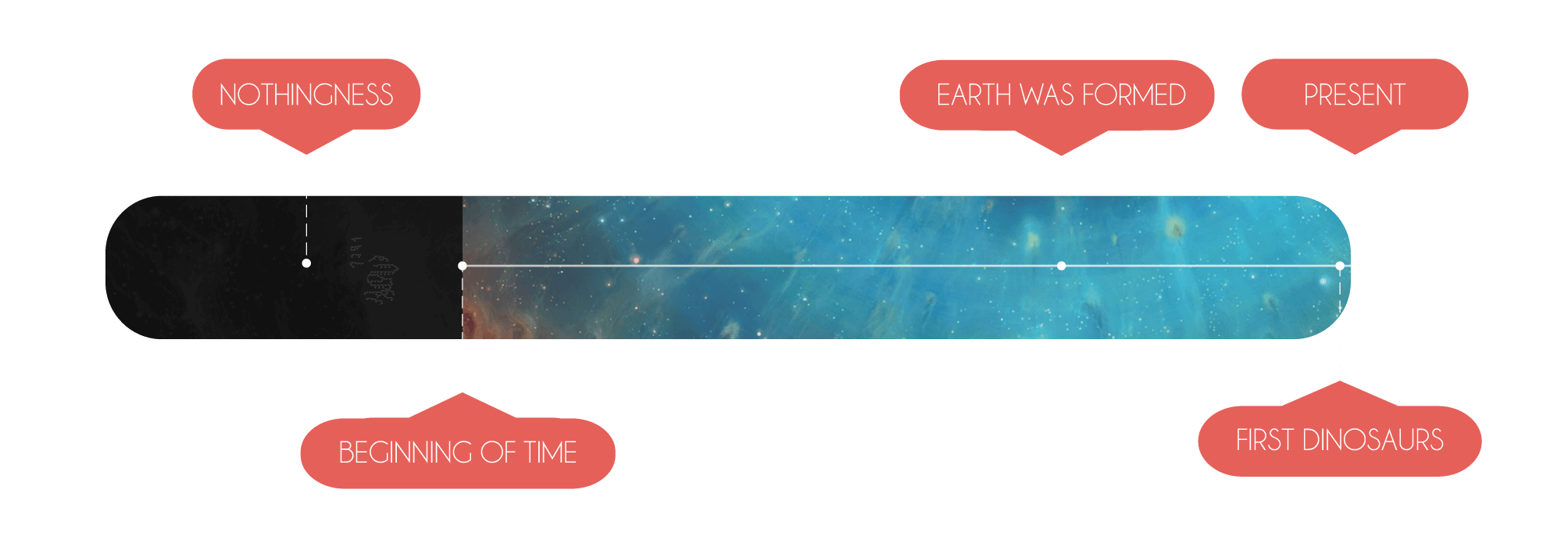
By all accounts, we seem to live in a universe whose arrow of time only goes in one direction – forward. Whether we like it or not, adventurous journeys into ancient history may forever remain a mere figment of human imagination. But what if we had the opportunity to travel back in time? We could live through yesterday or the year 2000. We could participate in the Second World War, spectate the development of first civilisations, or even observe the formation of our own planet. But how far would we be able to go? If our universe were static and eternal, we could travel as long as we would like. But from what we know, we do not live in such a universe. That is to say, on your journey, we would eventually arrive at the very beginning of time.
However, if we want to accept the theory that our universe had a beginning, we should focus on one crucial question – what was the universe formed from? Unfortunately, nobody knows the answer to this question yet, and there is a possibility that it is going to stay this way forever. But there are two options.
The first possible answer is that the universe was simply created out of nothing. It is not a great surprise that this idea, which defies both fundamental laws of physics and common sense, is not very likable. The second and a much more interesting option is that our universe was created because of a certain impulse. What impulse? Today, nobody knows. In the future, we might reach sufficient technological advancement that we will be able to study such an impulse. But right now, we can only argue and devise hypotheses. Perhaps the creation of our cosmos was caused by a collapse of a different (prior) universe, and thus we are just a link in an infinite set of universes, each one being created when the previous one dies. Perhaps the universe was born in a collision of two different universes. Perhaps.
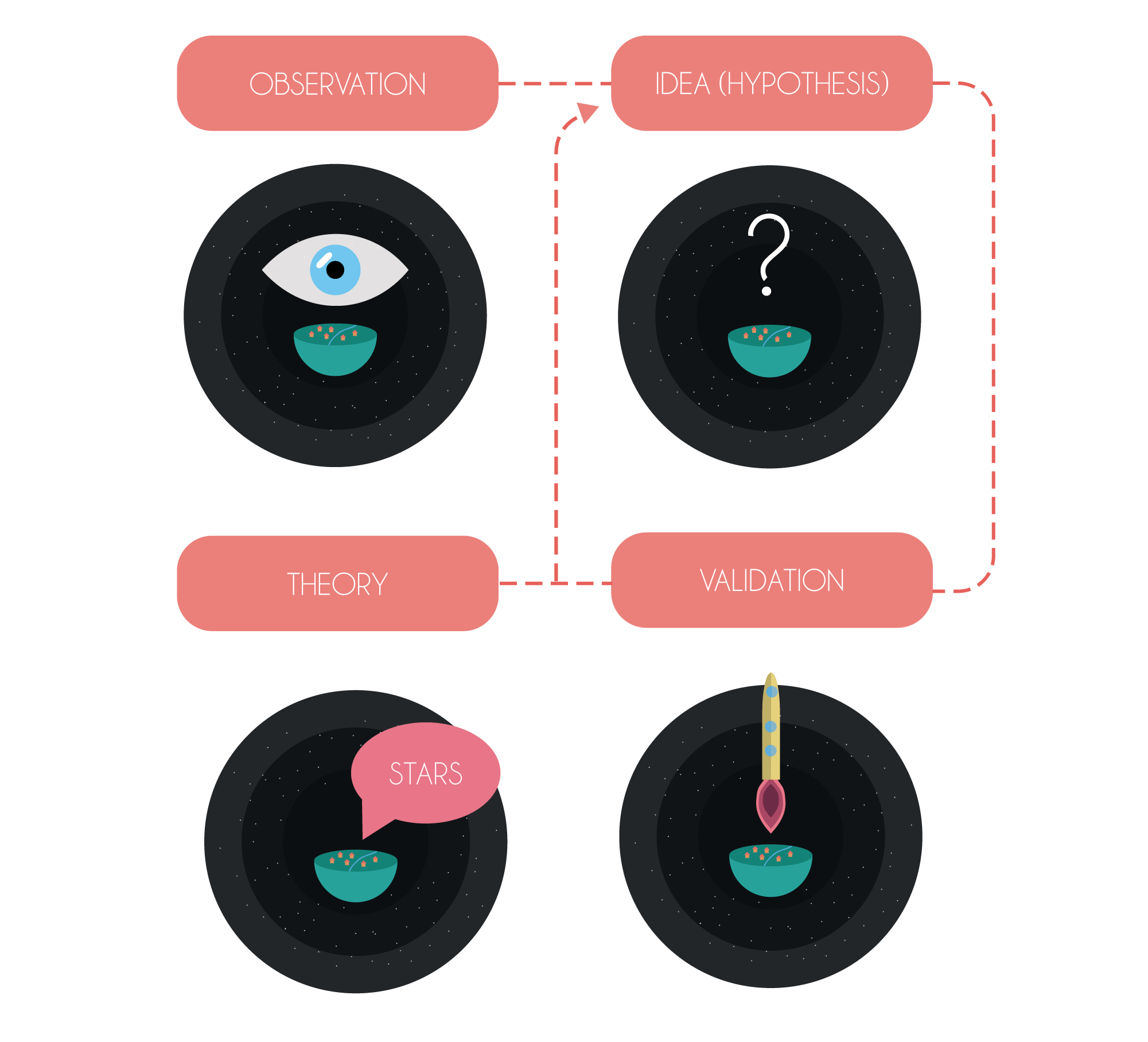
Even though we do not know the answer to this great question, there are certain things we do know about the evolution of the cosmos. Or – to be scientifically accurate – there are some things that we suspect. The essence of science is trying to understand the world around us as well as we can. We may achieve that by constructing hypotheses and authenticating them using the scientific method.
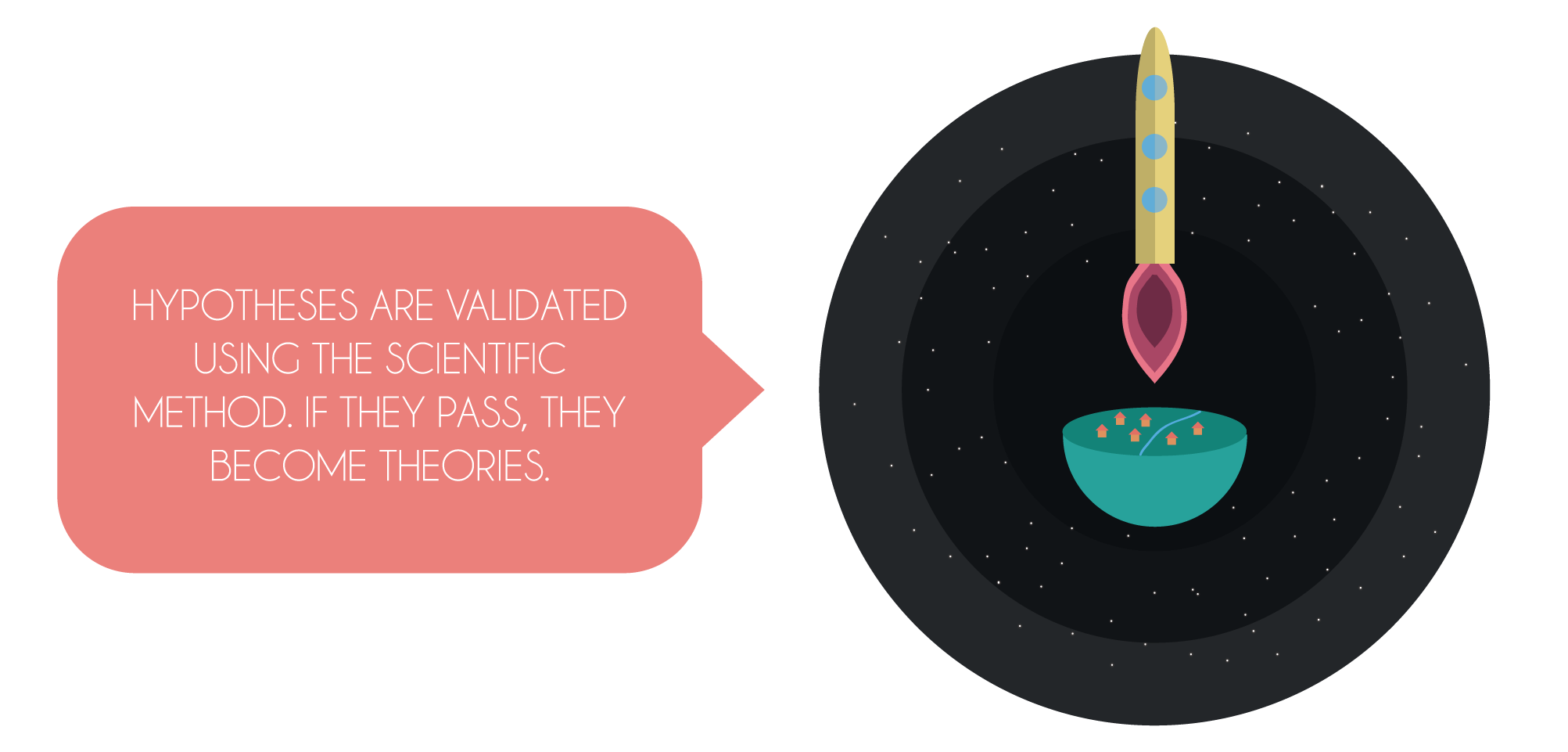
Anybody can devise a hypothesis. We can construct a simple thought experiment as an example – a prehistoric man sees strange dots in the night sky (today known as stars) and draws a conclusion that somebody must have painted them on the firmament – he has just created a hypothesis. To check the hypothesis, the prehistoric man builds a rocket (let us neglect the fact that the technical advancement of prehistoric people, whose apogee is knowing how to make fire, is nowhere near the level necessary to construct something as immensely sophisticated as a rocket) and sends this rocket far away, so that it can meet those mesmerizing dots – he is authenticating his hypothesis using the scientific method. Much to his dismay, the rocket is serenely wandering through space with no firmament in sight. His hypothesis has just been disproved.
However, if a hypothesis does pass all trials we impose on it, it is promoted to a theory. Now, we are finally talking about science, which is – in its purest form – a simple collection of such theories. Whether we are dealing with physics, psychology, biology, chemistry or astronomy, this element is common for all sciences. The entire human knowledge is just a large pile of theories, which are categorized into individual branches of science.
But there is another very important factor at play – some people consider theories an absolute, unshakeable truth. This view is incorrect. Science perceives theories merely as a collection of fragments, each of them trying to describe a tiny piece of reality. Some fragments are very precise, others not so much. If a theory is found insufficiently accurate, scientists are immediately ready to replace it with a different, better one. A good example is the multitude of theories which are trying to describe one of the most common phenomena in the universe – gravity. For many years, the best description of this mysterious entity by far was provided by Newton’s theory of gravity. However, it has been found somewhat inaccurate in some extreme cases. Eventually, it has been overthrown by Einstein’s general theory of relativity.
However, it was not such a long time ago that scientists realised that even general relativity is not perfect – it is not able to describe the gravitational interaction at the submicroscopic level. Unfortunately, no valid alternative has been found yet and general relativity is still awaiting its successor.
This example shows us the cruel truth about science – we can never be sure of anything. Even though we might think that we have revealed some tiny piece of reality, there is always a possibility that we have neglected a certain aspect of the cosmos in one of our theories, and thus something completely unexpected might happen. Who knows? Perhaps there is a space constant – whose existence is hidden from us – which will annihilate all of us. Perhaps the universe will die today.
There is nothing to worry about though. It is pointless to think about such things, since we are again finding ourselves in the treacherous world of hypotheses. Let us go back into the scientific world of theories, which still provides by far the best description of reality – despite its potential drawbacks. Specifically, let us devote our attention to a great theory that provides the best summary of everything we suspect about the creation of the universe itself – the Big Bang theory.
 Keishinrei