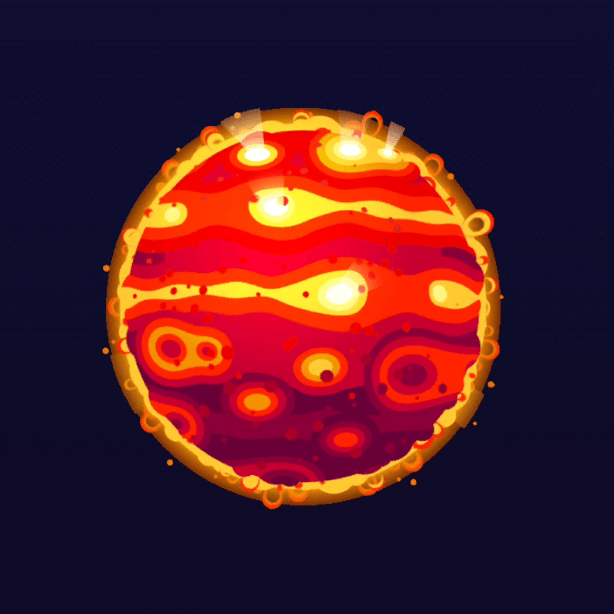
Picture a grain of sand on top of on SUV. That’s what the Sun would look like on top of Stephenson 2—18. If you wanted to fly in a passenger plane around this star once, it would be a 9-million—hour flight — a little over 1,000 years — and even in a lightspeed ship, the journey would take 8.7 hours. And if our home star were Stephenson 2—18 instead of the Sun, it would be bigger than Saturn’s orbit, and Uranus would be the new Mercury.
Stephenson 2—18 was probably born as a main sequence star a few tens of times the mass of the Sun and has likely lost about half its mass by now. While typical red hypergiants are in the ballpark of 1,500 times the size of the Sun, the largest rough estimate places Stephenson 2—18 at an absurd 2,150 solar radii and shining with almost half a million times the power of the Sun.
Stephenson 2—18 is the largest known star… kind of. The tricky thing is, red hypergiants are extremely bright and far away, which means that even tiny uncertainties in our measurements can give us a huge margin of error for their size. Worse still, red hypergiants are Solar-System—sized behemoths that are blowing themselves apart, which makes them harder to measure. As we do more science and our instruments improve, whatever the largest star is will continue to change.

 Keishinrei