The estimation of a star’s life expectancy has turned out to be quite simple. It only depends on one property – mass. The mass of a star determines all significant properties of the star – the aforementioned life expectancy, but also colour, temperature and obviously size. It also specifies its destiny. Let us focus on this chart now, which is known under the name of HR Diagram. This diagram is crucial for a deeper understanding of stars. With a bit of courage, it might even be said that the HR Diagram is one of the most eminent findings of astronomy:
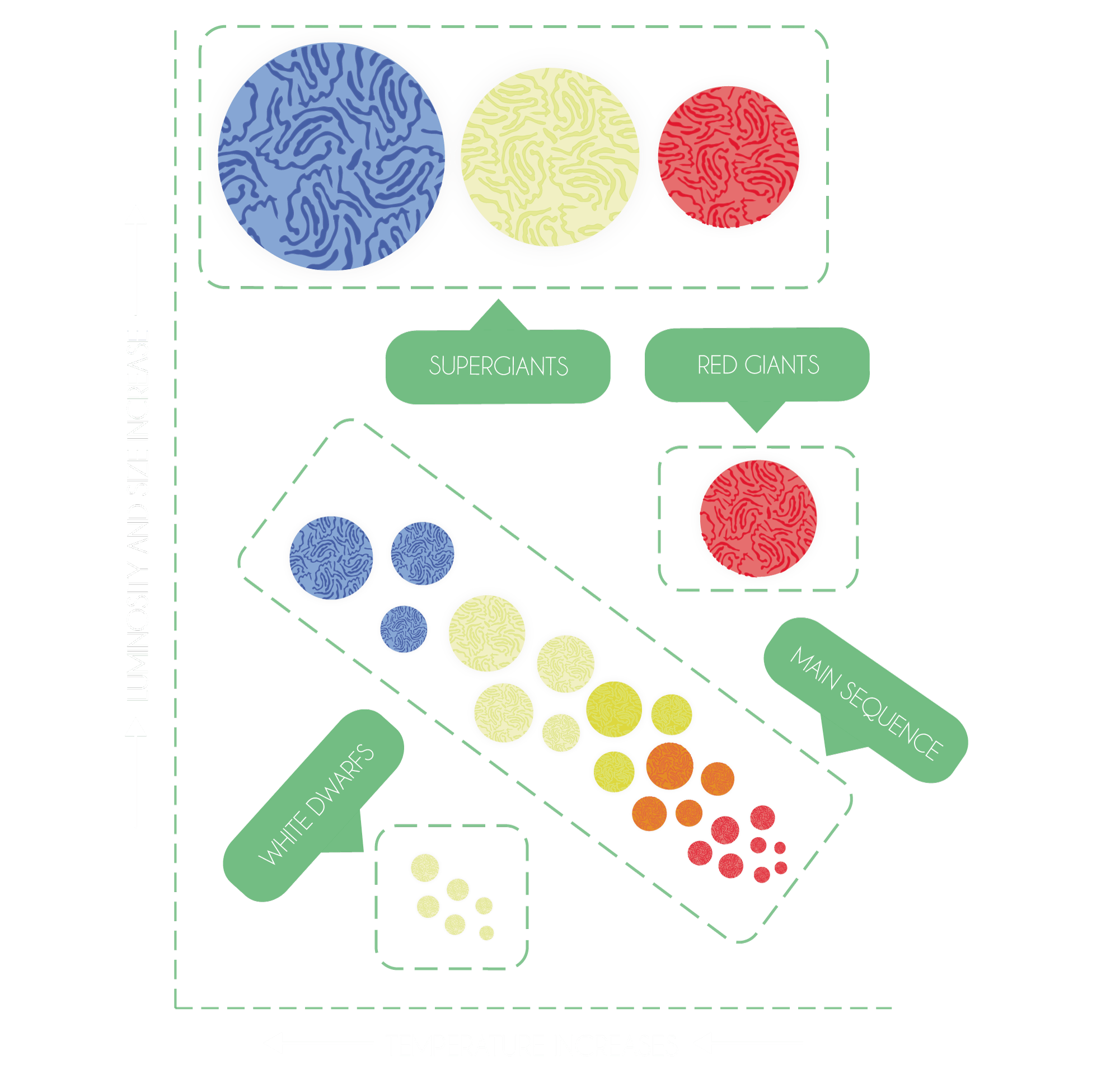
The diagram in front of your eyes classifies all stars in the universe – each star in the observable cosmos could be categorized into one of the categories above. First, let us focus on the most important part of the diagram, the main sequence, which stretches diagonally from the top left-hand corner to the bottom right-hand corner. At the start of its life, every star belongs among the stars of the main sequence. All the stars outside this sequence are either dying (giants and supergiants) or have been long dead and just keep harvesting the energy they have produced during their lifetime (white dwarfs).
Let us now describe the fascinating life story of individual star types. And let us begin with the very smallest ones, which a located at the bottom right-hand corner of our diagram. These stars have earned an apt nickname – red dwarfs.
The life of a red dwarf starts the same as the life of all the other stars – inside of a nebula. For some reason, however, red dwarfs have not been able to accumulate as much matter as their larger relatives – perhaps their nebula was too small or a different star forming in the same nebula has deprived them of some mass. Whatever the case, the mass of a red dwarf ranges from 0.1 to 0.5 solar masses. Their red colour comes from the fact that they have quite a low temperature, so they only emit red light, which has the lowest energy. What is truly remarkable is that more than three quarters of all stars in our galaxy happen to be red dwarfs.
However, if you wish to set your eyes on one of them, I have bad news for you. From the Earth, we cannot observe even a single red dwarf, since they have very small luminosity – sometimes even one ten-thousandth of the Sun’s luminosity. They compensate for this deficit by being able to glow for trillions of years. Red dwarfs are true masters of longevity – since the birth of the cosmos, not even one of them has used up its fuel in the form of hydrogen. Therefore, we cannot know how the life of a red dwarf ends – not even one of them has died to this day. But very likely they will end up in the bottom left-hand corner of our diagram as white dwarfs, where they will stay for another billions of years.
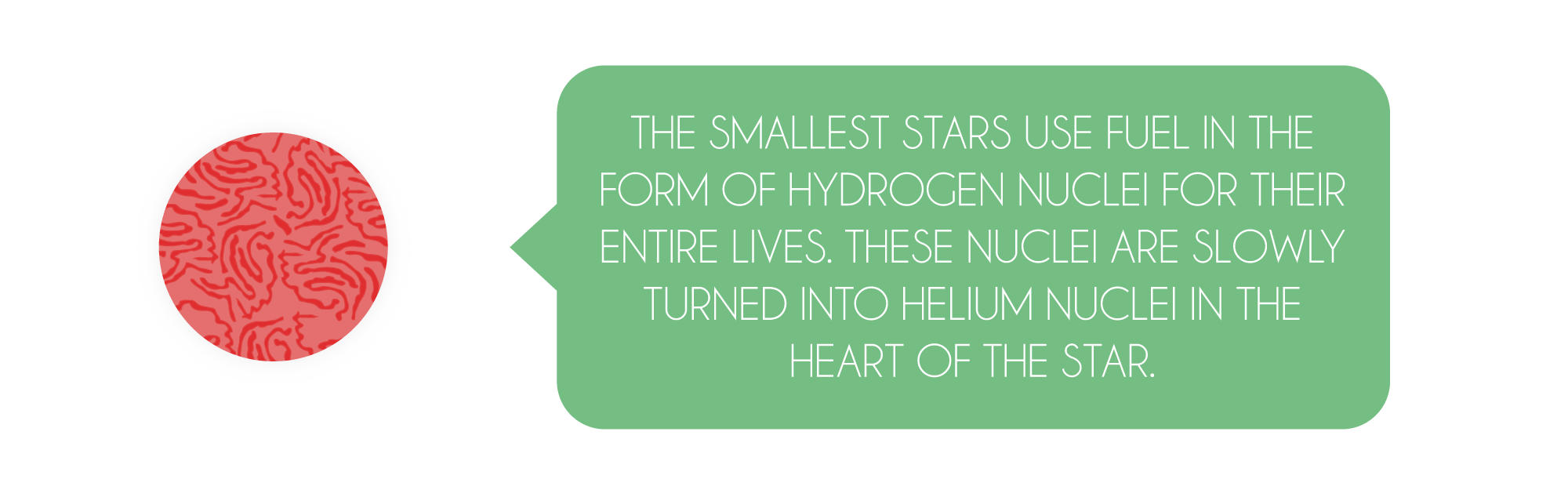
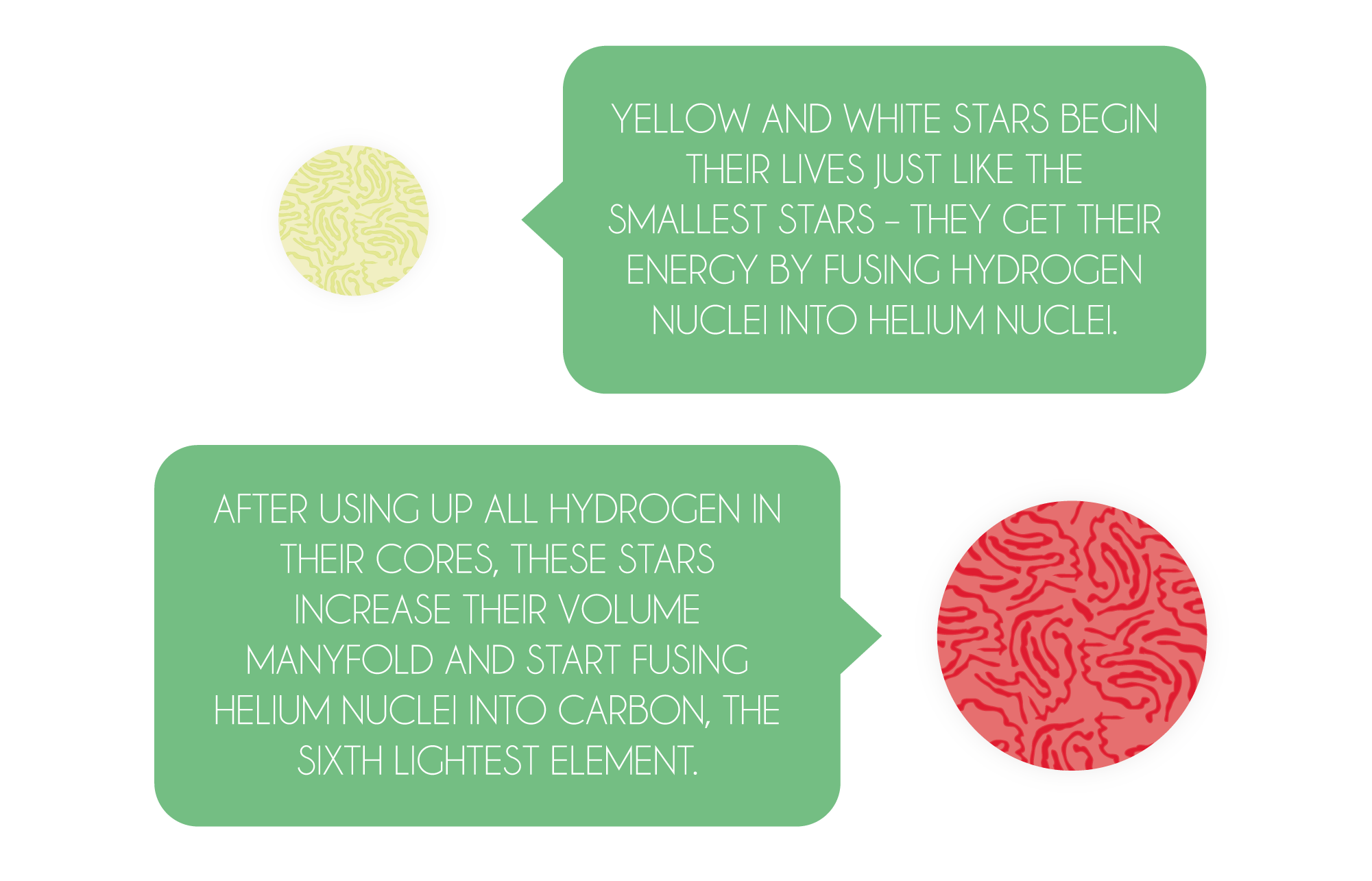
Now, let us move to the next category of stars. Stars of similar masses as our Sun (located in the middle of the main sequence) leave the world in a somewhat more spectacular way. At the beginning of their lives, Sun-like stars behave just like red dwarfs – they serenely link hydrogen nuclei and radiate heat. But they have much greater temperature, which gives them their yellow or white colour.
However, as a sacrifice for their greater luminosity, they die much faster. Once a Sun-like star depletes the hydrogen supplies in its centre, which usually lasts several billion years, the core begins to collapse rapidly under its huge gravitational pressure. The gravitational crash causes a massive rise in the core’s temperature – sometimes even a hundred million degrees Celsius. However, this temperature is sufficient for the star to start connecting helium nuclei (the second lightest element) in their cores and therefore avert its extinction temporarily.
But this trick has a little side effect. As the star starts fusing helium, its blistering core starts warming the surrounding parts, which causes a massive rise in the star’s volume and eventually its transformation into a red giant (the top right-hand corner of the diagram). It is appropriate to know one thing about red giants – the term giant is definitely not exaggerated.
It is estimated that once the Sun gets to the red giant phase, it will increase its diameter about 250 times. Imagine a football that just so happens to inflate to the size of a huge sphere 60 meters in diameter – a similar thing will happen to our Sun. It goes without saying that when it happens, it will not be a good idea linger anywhere in the vicinity of the Earth, unless you wish to be burned alive (the heat will become so intense that even mountains will begin to melt) or even pulled inside the Sun’s interior – scientists are still unable to agree as to whether the Earth will be at least partially spared from the Sun’s rampage, or whether it will be engulfed along with the first two planets of our solar system – Mercury and Venus.
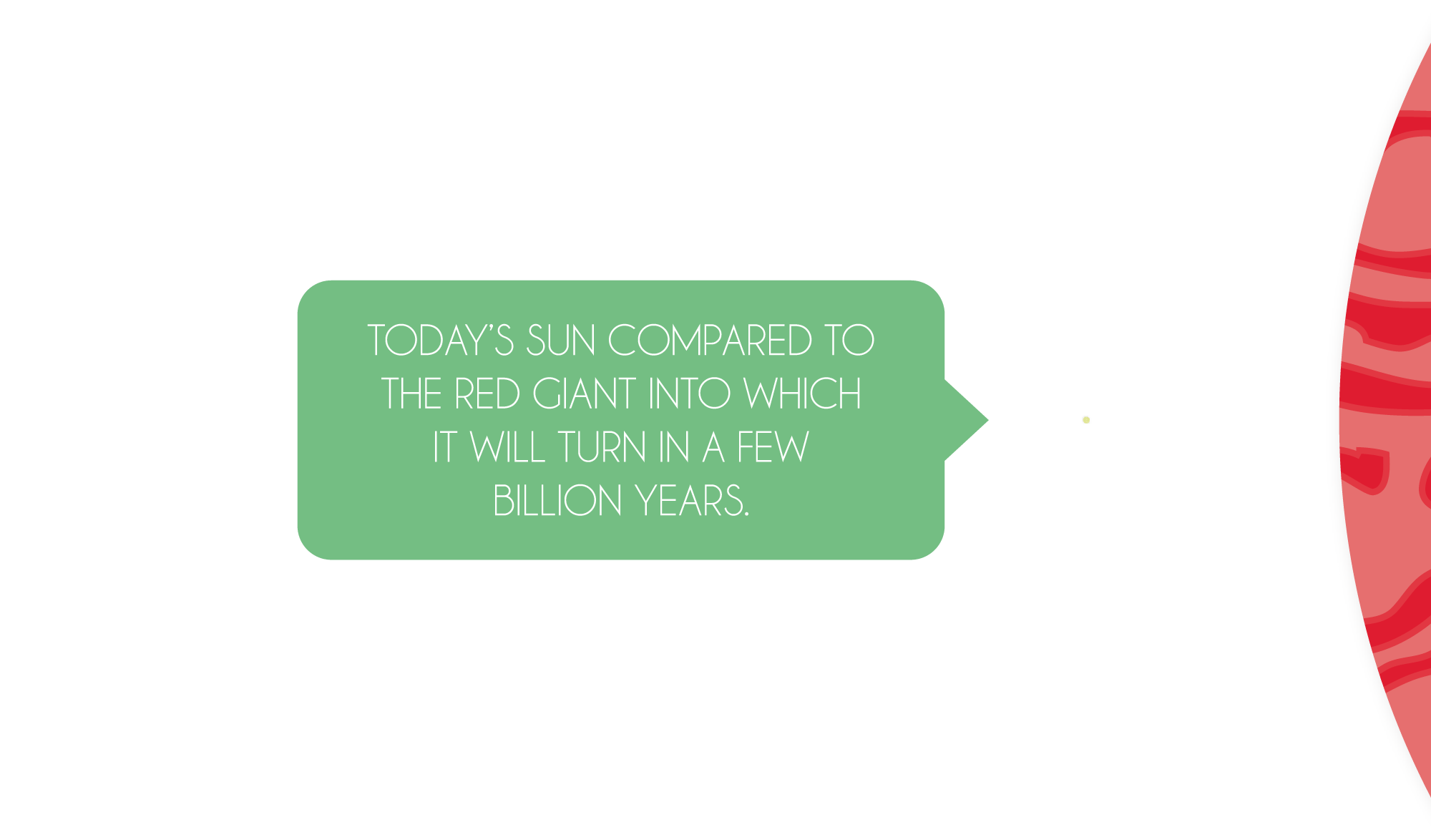
Whatever the case, if the human civilisation is still around at this point of time, it will roam a different part of the universe – perhaps humans will find a new home somewhere around Pluto, which will at that time provide a convenient temperature for the existence of water in its liquid form. But maybe they will depart to a completely different corner of the Milky Way galaxy. The only consolation provides the fact that it will take several billion years before our Sun swells so much. But let us go back to red giants.
Once a red giant exhausts even all of its helium, it spontaneously ejects billions of tons of material into the surrounding cosmos, and the sole thing left from the entire star will be its core in the form of a white dwarf. An average white dwarf is not much bigger than our own planet. Stars that used to be grandiose red giants therefore end their lives in the same way as red dwarfs – as relatively small space objects waiting to cool down. The whole life of such a star, from its birth to its majestic transition into a red dwarf, lasts a few billion years. If we compare that to those trillions of years red dwarfs can be proud of, we might even say that stars originating from the very centre of the main sequence do not seem to be particularly teemed with longevity.
Now, let us focus our attention on the most remarkable of stars – massive blue stars from the top left-hand corner of the main sequence. The lower limit of their mass is about ten solar masses, but some can reach up to a hundred solar masses. These stars are incredibly luminescent – sometimes even a million times more than the Sun. For this reason, they quickly burn all of their fuel – a star fifty times more massive than the Sun exhausts all of its hydrogen in “just” one hundred million years. After that, blue stars use the same trick as their smaller companions and start fusing helium atoms as giants.
But their pilgrimage is far from finishing here. Once they burn all the helium in their cores, they move to the next stage of their lives, a stage that is even more impressive than the previous one – they become supergiants. It goes without saying that supergiants are enormous. Their diameter is often even a thousand times greater than that of the Sun (and a hundred thousand times greater than the diameter of our tiny planet).
Due to the huge temperature in their cores, supergiants present determined machineries with only one purpose – to assemble heavier elements. While lighter and cooler stars are only able to fuse helium nuclei, which makes them capable of creating carbon nuclei at most, supergiants are definitely not frightened to create even much heavier nuclei. Their endeavour does not stop until it reaches iron – the 26th lightest element. Iron presents the final milestone for fusion. The arrangement of particles in iron’s nucleus is so energetically efficient that whenever iron fuses with a different nucleus, energy is consumed, not created.
At iron, supergiants therefore reach the fatal breaking point – the only efficient tool they have had to counteract gravity betrays them, which means they can no longer resist their gravitational collapse. The atmosphere of the star starts to drift towards its heart under an incredible velocity. After a few minutes, it reaches the star’s nucleus. Once there, the whole atmosphere is bounced back with a tremendous power. The result is an immense explosion in the form of a supernova.
Imagine the overwhelming energy of the nuclear bomb that wiped Hiroshima off the face of the Earth back in 1945. Now multiply that energy million million million million times. Why? Such is the energy released during a supernova explosion. This stellar explosion is so enormous that it cannot possibly be expressed by any superlative. A supernova can outshine the collective brightness of all other stars in its entire home galaxy.
During the explosion, the star has so much redundant energy that it even starts producing elements that are heavier than iron. An average supernova explosion takes only about a minute. In such a brief period of time, an exploding star is able to assemble all of 92 naturally occurring elements of the universe. Heavy elements, such as zinc, iodine, or uranium would never see the light of day were it not for the staggering supernova explosions, since nothing else in the universe simply has the amount of energy necessary for their construction. It is mesmerizing when we realise that all heavier elements around you have once been ejected by one of the ancient supernovae of the early universe.

 Keishinrei