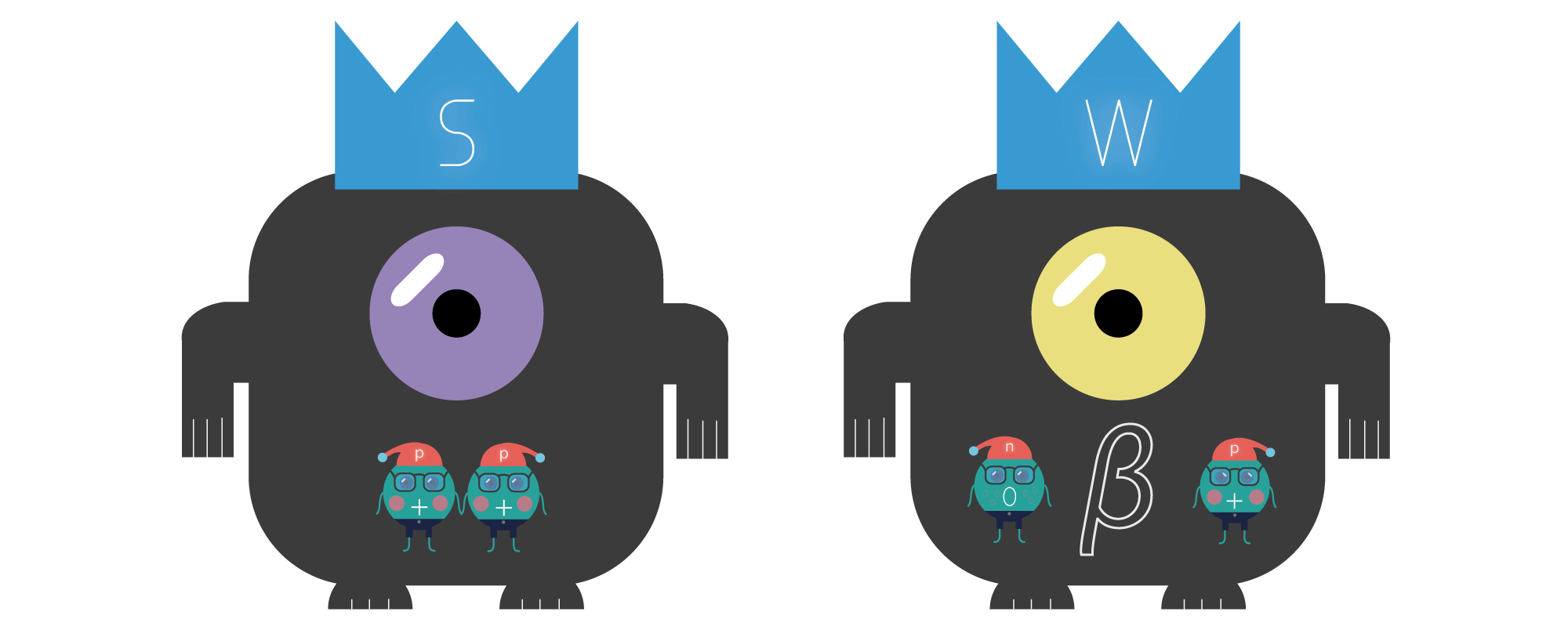
The strong interaction is, as suggested by its name, the strongest of all interactions. It is about a hundred times stronger than electromagnetism (and about a hundred trillion trillion trillion times stronger than gravity). How is it possible that we almost never hear about this interaction if it has such an immense strength? The problem is that its range is just billionth of a millionth of a meter. It may seem that a force with such a short range would never be able to influence our universe in a significant way, but the truth is that without the strong interaction, humans would never be able to exist.
As already mentioned, the universe was flooded with elementary particles right after the Big Bang. Those then started clumping together to create composite particles – quarks started forming protons and neutrons. But what caused them to attract? Why were quarks so keen on creating more complex particles? As you may already suspect, the attraction between individual quarks was provided by the strong interaction.
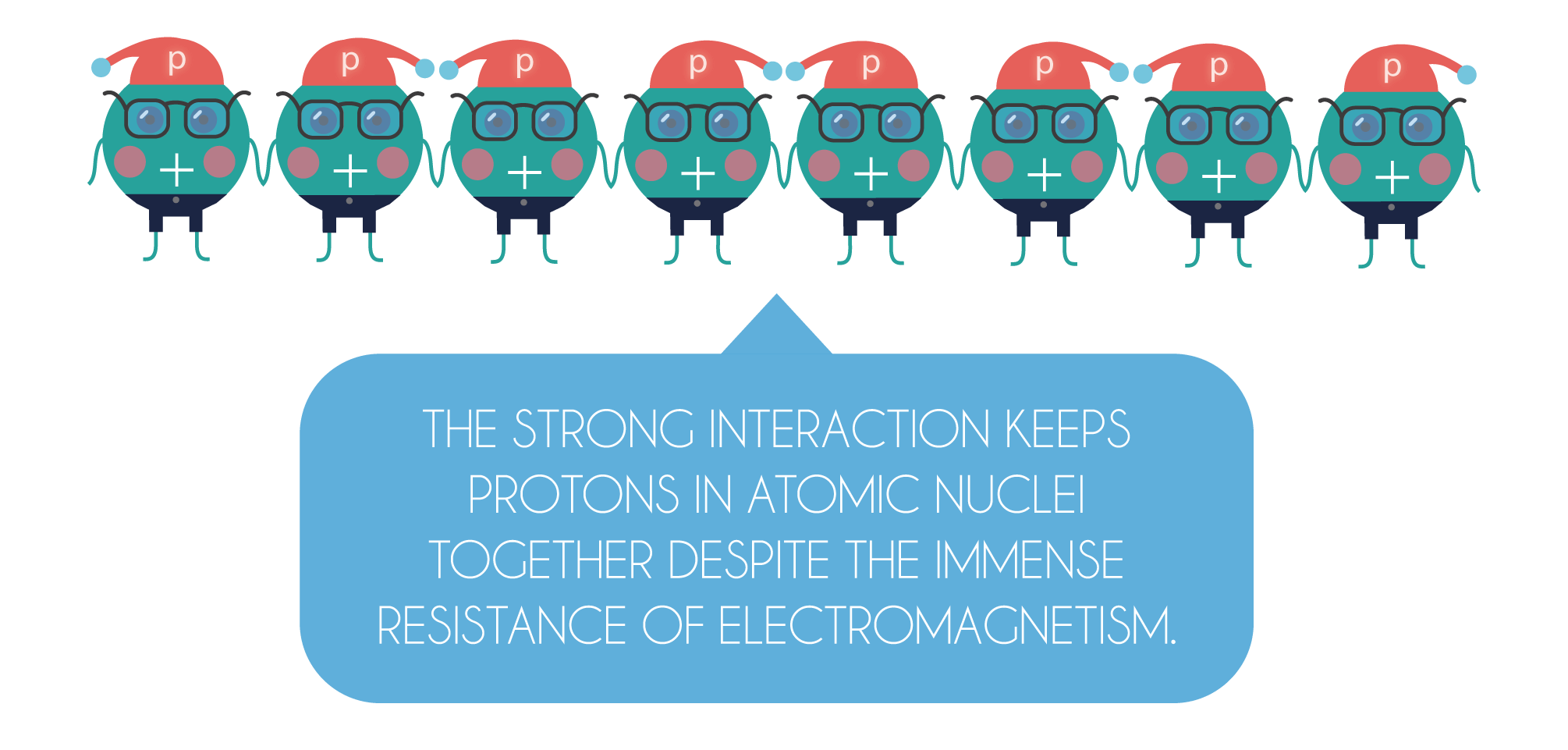
It does not end here, though. The strong interaction is to blame for another crucial phenomenon of our reality – the existence of atoms. We already know from the previous chapter that the same electric charges repulse each other. However, this means that protons in the nuclei of complex atoms should repulse and escape into all conceivable directions. But the strong interaction ensures that protons remain together. If electromagnetism were just a tiny bit stronger than the strong interaction, the existence of atoms would simply be impossible.
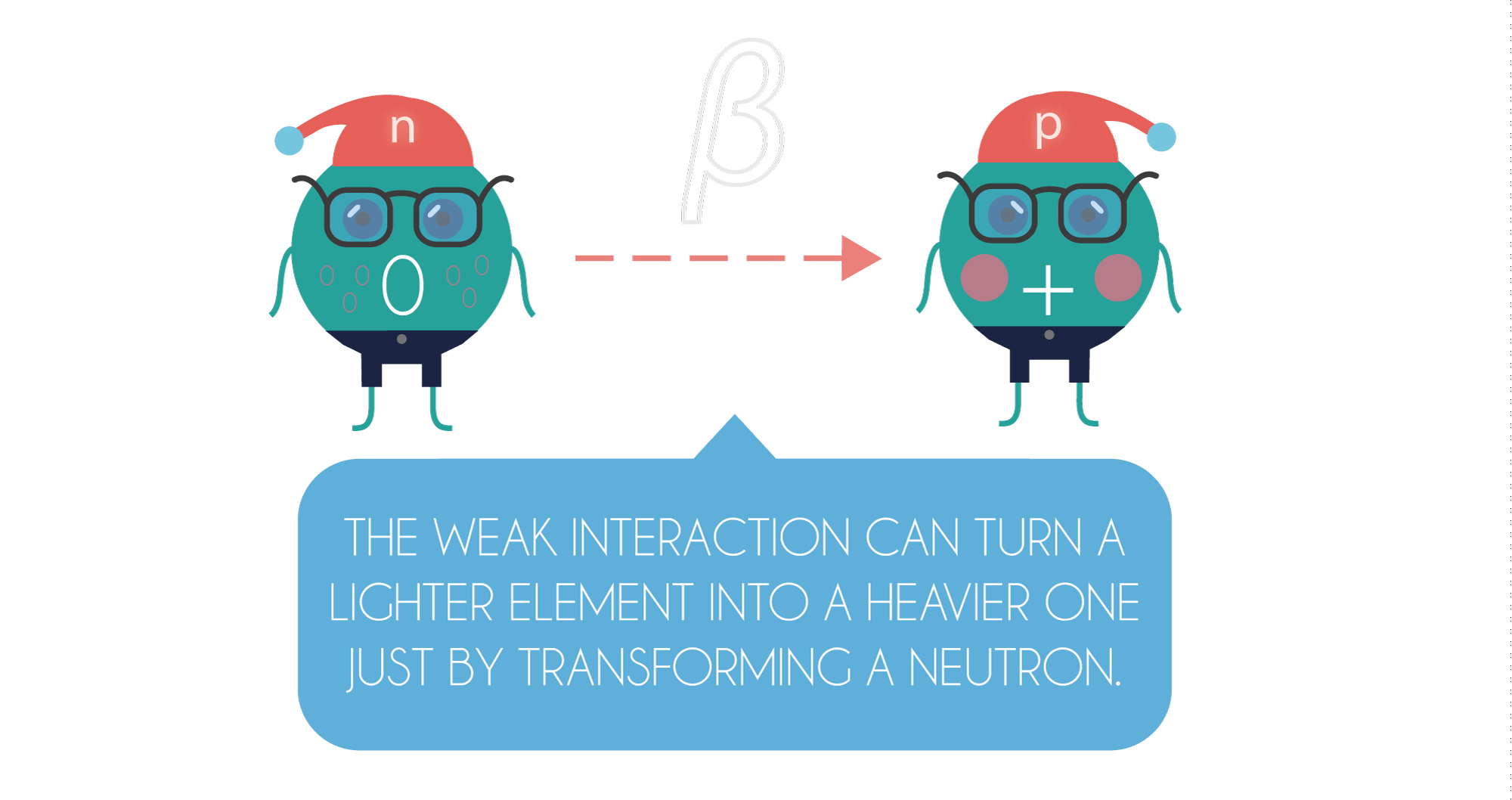
The final force, the weak interaction, may be the least known and the least interesting of all interactions. However, this is not to say it is not important. The weak interaction has the power to turn a neutron into a proton. Why would it do that? Within some atoms, there is an unstable ratio between the number of electrons and the number of protons in the nucleus. And the weak interaction is here to make sure that this instability is eliminated. When there are too many neutrons in a nucleus, the weak force simply turns one of them into a proton. This phenomenon is called the beta decay.
As we know from the first chapter, the number of protons in the nucleus determines what atom we are dealing with. But this means that any time an atom undergoes beta decay, which adds one proton into its nucleus, the whole atom changes into a different element. The weak interaction can therefore turn carbon into nitrogen or hydrogen into helium just by turning neutrons into protons.
And that is all. We have reached the end of the story of interactions. They make sure that our universe functions the way it does and without them, we would have never existed – perhaps with the exception of the weak interaction, which is the only one that does not affect the course of the cosmos in a significant way. Now, we can focus our attention on another fascinating element of our universe – huge fusion factories which are making billions of photons each moment.

 Keishinrei