At the very beginning, there was a peculiar object called the singularity, floating in nothingness. How did it get there? That is a mystery. However, before we start exploring this immensely interesting object, we should focus on a different, seemingly trivial expression – nothingness.
Some might think that all the “empty” space around us could be considered nothingness. But that can hardly be the case, given that each centimetre of air contains billions of atoms.
Others might argue that the vacuum of space could be classified as nothingness. After all, vacuum is empty by definition – it contains no matter whatsoever. But there is a catch – vacuum is inside the universe just like everything else around us. And the universe is interwoven with space-time filaments. But space-time certainly is something. It is a specific area where all the laws of our universe are in effect.
For this reason alone, one cannot consider vacuum as complete nothingness, not to mention the immense amount of particles that are being created each second in every single tiny bit of vacuum as a result of quantum mechanics.
But the nothingness around our initial singularity was special and unique – time and space were non-existent and the laws of physics powerless. We would never be able to find such nothingness in our cosmos.
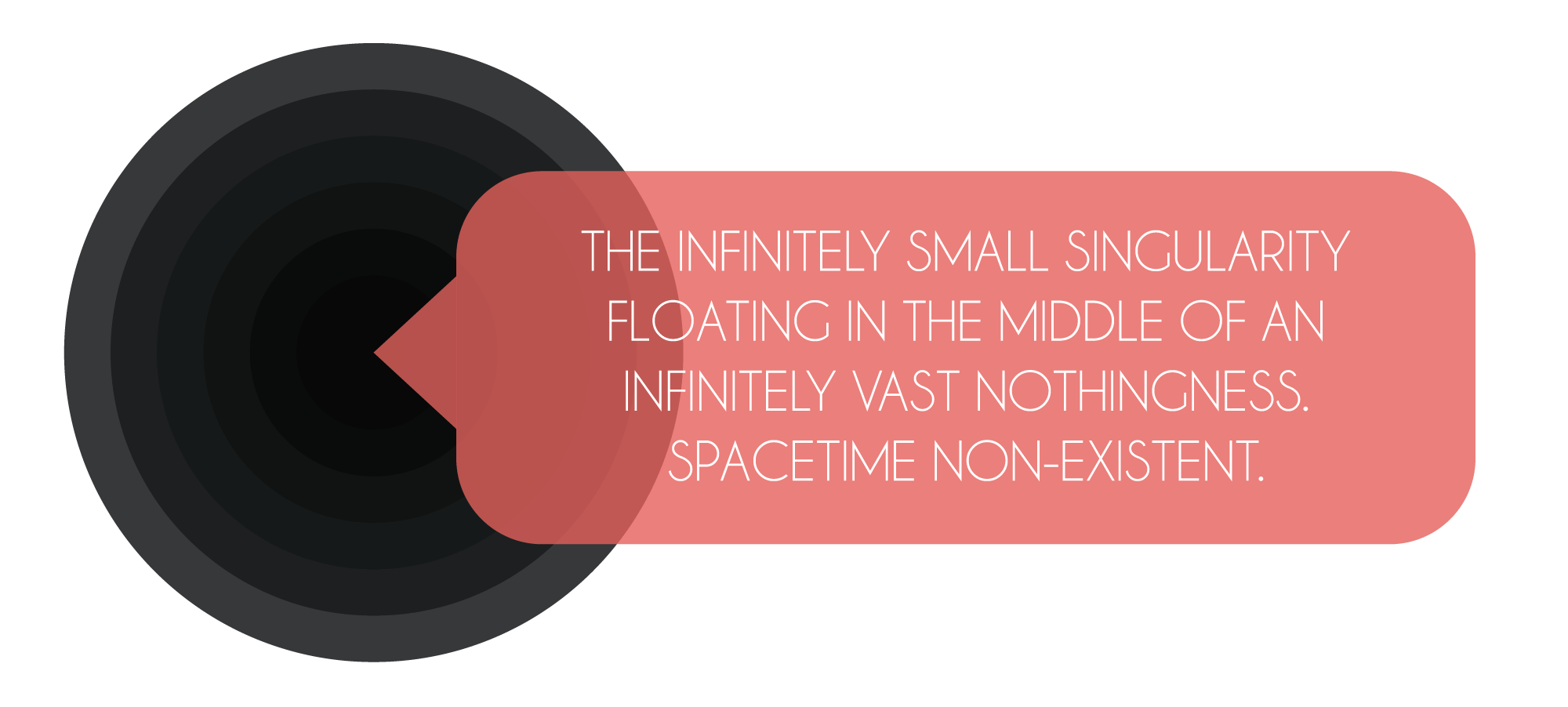
Back to our singularity. It would be fitting to say that it was an exceptionally peculiar object. We do not get to see such objects every day – never, in fact (unless we find ourselves in the centre of a black hole, which would probably not be an unduly pleasant experience – we are going to look into that in one of the following chapters).
Why was the initial singularity so peculiar? First of all, it may have been infinitely small, which is more than remarkable. On top of that, it was infinitely dense and infinitely hot, which makes good sense given that the entire universe had to fit into its heart. Exactly – everything you see around you has once been squeezed into this ancient singularity, though in a somewhat different form.
Suddenly, something incredible happened. Something that may be considered the strangest and most mysterious event of all time. The singularity started rapidly expanding and created the entire unbelievably huge universe. This incident is known under the majestic name of the Big Bang. However, it is rather ironic that we are using this name. First of all, this expression was coined by a man named Fred Hoyle, who was a tremendous opponent of the Big Bang theory (he favoured the competing Steady State theory). He only used this expression to mock the theory. In addition, the term “Big Bang” is incredibly inaccurate – it is far from representing the event that actually occurred.
Let us focus on the word Bang first. This word seems to represent a grand explosion accompanied by stunning sound effects. Much to the dismay of action movie fans, the actual “Big Bang” could be considered the exact opposite of such an explosion. There is no sound in vacuum, so let us forget about amazing sound effects. But more importantly, the Big Bang was not an explosion at all – it was more like an inflation of space (incredibly fast inflation indeed).
A great parallel is the inflation of a balloon. Imagine that our universe is represented by the surface of a balloon. If we inflate it, the distance between any two points on its surface increases. This is what the Big Bang and the following expansion of space looked like – it started off as an infinitely small point in the form of a singularity, and ended up as the surface of a gigantic “space balloon”. (Except that the surface of a balloon is a two-dimensional space curved in a third dimension, while our own universe is most likely a three-dimensional space curved in a fourth dimension. However, our primitive three-dimensional brains are not capable of imagining fourth-dimensional space – that is why we are using a simple balloon analogy.)
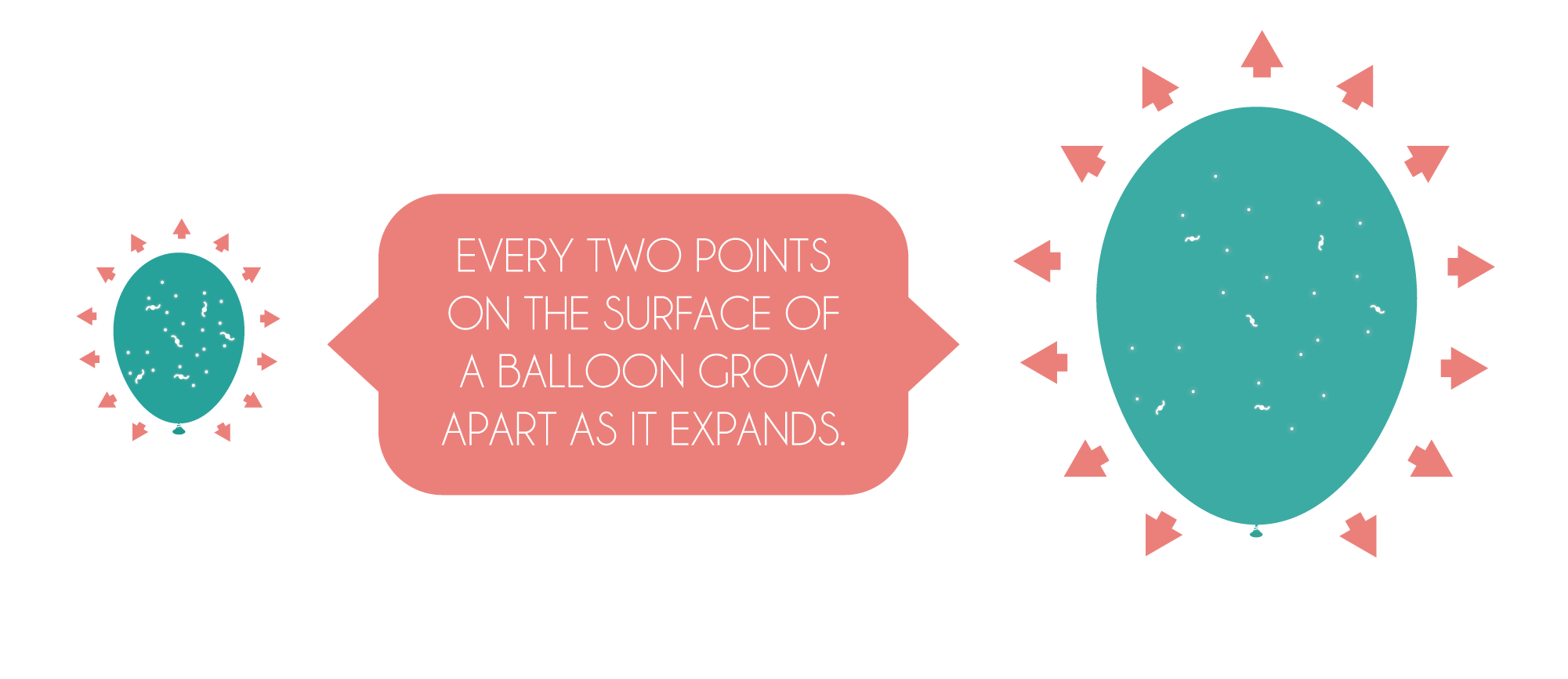
Now that we grasp the issues with the word Bang, let us focus our attention on the word Big. While the word Bang is utterly inaccurate, the word Big is correct. However, it is a tremendous understatement. The Big Bang was not only big, it was everywhere – every single tiny bit of space used to be condensed in an infinitely small singularity and underwent a whopping expansion. To augment our balloon metaphor, imagine that you are a two-dimensional ant inhabiting the surface of the expanding balloon. For such an ant, the surface of the balloon is the only thing in existence – the ant cannot escape it on its own. From its point of view, everything is inflating. For the sake of accuracy, it would be appropriate to replace the word Big with the word Huge – or even better, Omnipresent.
However, if we put these two accurate expressions together, we get something like the Omnipresent Inflation, which, let us admit, does not sound nearly as good as the Big Bang. We will therefore stick with the usual term, now with the knowledge of its imperfections.
One of the greatest questions is when exactly the Big Bang occurred. This immensely interesting question has been subject to discussion for decades. Today, it is assumed that the singularity started expanding astounding 13.8 billion years ago. You do not even have to try to understand how long ago it was – for the human brain, it is practically impossible. But we can at least try to present this information in a different way – imagine that you put marbles one centimetre (0.4 inches) in diameter next to each other into a single row. If each marble represented one year of the universe’s existence, your row of marbles would go around the entire Earth. Three times. And if you by any chance wanted to live through the whole age of the universe, you would have to live incredible 200 million average human lives. For comparison, the Earth is about 4.6 billion years old – about 67 million lives.
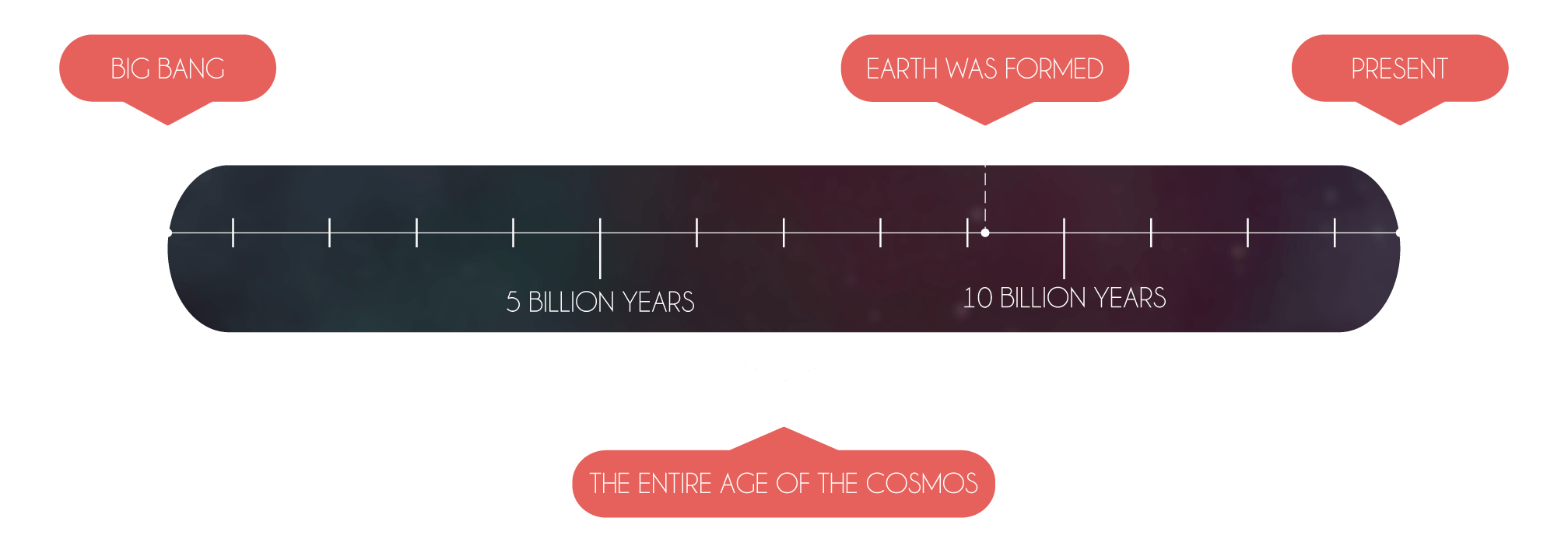
Let us come back to the very beginning now. No one really knows why the Big Bang occurred, but we do know quite well how exactly this process took place. 13.8 billion years ago, the singularity, containing the entire energy of the cosmos, started rapidly expanding. This moment is considered to be the beginning of space-time as well as the universe itself.
But what happened before the Big Bang? This seemingly interesting question is actually pointless. Time is inherently woven into the structure of our universe. Before the Big Bang, it simply did not exist. Asking this question is like wondering about what is located north of the North Pole.
As you have surely already understood, most things about the singularity are extreme and unimaginable. And the super-rapid expansion of the early cosmos right after the Big Bang is surely no exception. Trying to imagine any of the numbers bellow is simply impossible.
About a billionth of a billionth of a billionth of a second after the Big Bang, the universe entered a monumental state known as the cosmic inflation. It should be noted that the temperature of the cosmos at that time was respectable 100 million million million million degrees Celsius! During the cosmic inflation, the universe increased its size in an unimaginable manner. From the initial size of less than a billionth the size of a proton, it inflated to a comparatively huge sphere 1 centimetre (0.4 inches) in diameter. But even more remarkable is the fact that it has managed to alter its size like this in a mere fraction of a second – the cosmic inflation started about 10-37 seconds after the Big Bang and ended somewhere between 10-35 seconds a 10-32 seconds after the birth of the cosmos.
And in a blink of an eye, the cosmic inflation was gone forever. Space-time continued on its expanding journey (in fact, it continues expanding to this day), but much more slowly. At the end of the inflation, the temperature of the universe was about a 100 thousand times smaller than at its beginning. It is mesmerizing that in a moment much shorter than anyone can even imagine, the universe changed so dramatically. But what is most important – once the cosmic inflation was over, the cosmos already contained a crucial component which makes our very existence possible – matter.

 Keishinrei